



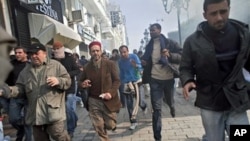
Many observers are wondering what will happen next for Tunisians. Recently, the country’s longtime leader, Zine El Abidine Ben Ali, left the country as civilian protestors demanded a new government.
Some are asking whether Tunisia’s long-standing ties to the West will continue, whether Islamists will play some part in a future Tunisian government, and will Tunisia’s economy, considered by many to be among the most stable in the region, remain strong.
|
VOA's David Byrd speaks with University of South Carolina Tunisia Scholar Kenneth Perkins:
|
Tunisia scholar Kenneth Perkins, professor of history at the University of South Carolina, says “it is true that Tunisia’s economy appeared to be prosperous, but while some people benefitted, many outside Tunis, in remote areas, did not see the results of Tunisia’s prosperity.”
Author of A History of Modern Tunisia, Tunisia: Crossroads of the Islamic and European Worlds and Historical Dictionary of Tunisia, Perkins says one example is students who completed university degrees but often found it difficult to obtain employment commensurate with their skills unless they were willing to go to Europe.
One area of Tunisian society that will be closely examined is the middle class, reputed to be larger than other countries in the region. One question to be answered is what will happen to this segment of society as the so-called "Jasmine Revolution" takes hold.
“It has the potential to benefit the Tunisian middle class because this has been more of a middle class movement than normally occurs during civilian upheavals,” said Perkins.
The University of South Carolina historian also says the Tunisian middle class has not only been concerned about economic matters, but is interested in political freedom and the ability to openly express themselves without threat of retaliation.

“Zine El Abidine Ben Ali held the country very tightly. He led an autocratic regime in which the ability to express dissent in a meaningful way was limited,” noted Perkins.
He sees the restrictions of the Ben Ali government on the Tunisian people as a “powerful factor” in the recent events that led to a change in the country’s leadership.
Another question that will be answered in the coming years is if other countries in the region were affected by the revolution.
Perkins says the nature of Ben Ali’s regime was comparable to the leadership of other countries such as Egypt, where President Hosni Mubarak allowed “small political openings, but not producing meaningful political participation” or democratization.
“I think in Egypt, in Algeria, in countries particularly throughout the western Arab world where ties with Tunisia are strong they may be looking at the revolution as an inspiration,” contends Perkins.
|
Zine El Abidine Ben Ali Rachid Ghannouchi |
He says the people conducting the Tunisian revolution have relied heavily upon social media to communicate with one another, the region and the rest of the world.
“People in neighboring countries are well aware of what has been going on in Tunisia and many would like to see something similar happen in their own countries,” said Perkins.
Whether Islamists have a place in any future Tunisian government and if there is any similarity between the Iranian revolution, which began more than 30 years ago, and what is happening in Tunisia is another area that Perkins intends to examine.
“There was an Islamist movement in Tunisia in the 1980s and 1990s that was thoroughly crushed by the Ben Ali government,” said Perkins. “This happened at a time when Algeria was going through difficulties which were tied to Islamist movements. In order to prevent those currents from carrying over into Tunisia, the [Ben Ali] government took repressive actions against Tunisian Islamists even though they were more progressive than Islamists in other countries.”
Perkins believes current conditions in Tunisia could allow for a reemergence of the Islamists.
“There are lots of critiques of the current government and the Islamists may be in a position to take advantage of that, but large numbers of Tunisians, especially those in the middle class, do not find the Islamist movement speaks to their interest, hopes and desires,” he said.
Perkins says the U.S. should continue to support democracy and civil society in countries like Tunisia.
“From a security point of view Tunisia was perceived by the U.S. as an ally and I don’t think that will change even if the current government were to be replaced. Tunisia’s ties to many of the values of the western world are very strong,” he added.
Perkins says that Tunisia is a secular state which places a lot of emphasis on education, women’s rights and other liberal ideals and he doesn’t “see those things changing.”