



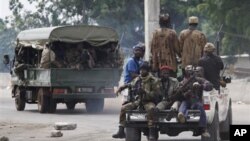
Forces backing Ivory Coast's internationally-recognized president Wednesday renewed their assault on the country's incumbent president after he refused to admit electoral defeat and surrender. Fighters backing the incumbent president appear to have turned back the assault.
Forces backing Ivory Coast's internationally recognized president Alassane Ouattara waited more than one day for French and United Nations officials to negotiate incumbent president Laurent Gbagbo's surrender.
When Mr. Gbagbo refused to acknowledge that he lost November's vote, pro-Ouattara forces renewed their attack in what they said was a final push to end the four-month political crisis. But Gbagbo loyalists appear to have repulsed that attack and again prevented Ouattara fighters from over-running Mr. Gbagbo's residence.
U.N. and French attack helicopters destroyed heavy weapons at Mr. Gbagbo's residence and his main military barracks Monday. Gbagbo allies say the U.N. and French forces were also involved in Wednesday's fighting as part of what they call an assassination attempt against Mr. Gbagbo, a charge that French officials deny.
The U.N. mission in Ivory Coast says it is acting to defend civilians and peacekeepers in line with its Security Council mandate. Ouattara forces say they are under orders to capture Mr. Gbagbo alive.
Nigeria's U. N. Ambassador Joy Ogwu says it is time for Mr. Gbagbo to go. "We want to see Gbagbo out so that the process of reconciliation and reconstruction can begin to take place. We still have miles to go and the sooner he surrenders and gets out, the better for everyone. There is a lot of work to be done in terms of reconciling the warring factions, the various factions in a diverse society," he said.
Mr. Gbagbo's refusal to accept an offer from the West Africa regional alliance for a safe and dignified exit is the latest and perhaps one of his last acts of defiance as he chose to remain in an underground bunker, refusing to back down from his claim that he was re-elected when the constitutional council annulled as fraudulent nearly 10 percent of all ballots cast in his run-off election with Mr. Ouattara.
Mr. Ouattara's claim to the presidency is based on electoral commission results certified by the United Nations.
Hundreds of people have died since fighting began in December, including many civilians. The U.N. is investigating reports of mass killings last week in a western province near the Liberian border.
View related slide show