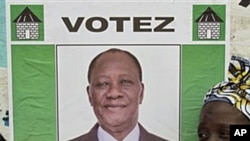
Ivory Coast's electoral commission says the country's former prime minister has won the presidential election. The incumbent president is challenging those results.
Electoral Commission Chairman Youssouf Bakayoko says Alassane Ouattara won more than 54 percent of Sunday's vote, defeating incumbent President Laurent Gbagbo.
Those provisional results now go to the country's constitutional council where Mr. Gbagbo wants some of those results annulled. Council chief Paul Yao N'Dre says final results will be announced in the shortest possible time.
N'Dre says the council wants to reassure the Ivorian people and the international community that all instruments of power will continue to function normally while the council considers definitive results.
N'Dre is a Gbagbo ally who quickly rejected opposition complaints about the conduct of the first round of balloting. Gbagbo supporters are looking to the council to annul results from three northern districts where they say Ouattara's campaign engaged in electoral fraud.
President Gbagbo extended an overnight curfew ahead of the electoral commission's failure to meet its Wednesday deadline to announce a winner. But despite that curfew, Ouattara supporters say eight people were killed in an overnight attack in Abidjan.
Local youth chairman, Idrissa Ouattara, says masked gunmen attacked party headquarters in the Yopougon neighborhood.
Ouattara says unarmed members of the party's youth wing volunteered to stay overnight at the local headquarters because of concerns about post-electoral violence. He says they were attacked by more than 40 people who stormed the party offices, killing eight people and injuring 14. Ouattara says 25 people are unaccounted for.
He says the attackers were shouting that Ouattara supporters voted for a foreigner, and a foreigner will never govern Ivory Coast. The former prime minister is from the north of the country where many people are descendants of migrants from Burkina Faso and Mali.
Ouattara supporter Abduallai Bamba spent the night at the Yopougon headquarters. He sat Thursday with dried blood down the front of his white T-shirt, a large bandage covering the right side of his head.
Bamba says the attackers used clubs and long knives. People were falling everywhere, he says. They were all wearing civilian clothes, so he does not know who they were.
Electoral Commission Says Opposition Candidate Wins Ivory Coast Election