


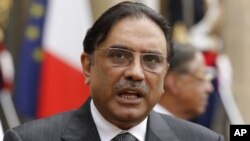
ISLAMABAD - Pakistan's president will attend the upcoming two-day NATO Summit in Chicago that will discuss the international community's role in Afghanistan after all foreign combat troops withdraw from the country by the end of 2014. Meanwhile, negotiations continue between Pakistani and U.S. officials on the reopening of NATO supply lines to Afghanistan.
The Pakistani government says President Asif Ali Zardari has decided to visit Chicago after the country’s Cabinet and its defense committee endorsed a last-minute invitation to the NATO summit.
The alliance extended the invitation earlier this week after Islamabad suggested it would soon re-open ground supply routes to U.S. and NATO forces in Afghanistan.
“The president would visit Chicago. He would attend the conference,” Prime Minister Yousuf Raza Gilani told reporters in Islamabad Thursday.
Gilani insisted the invitation was not conditional on whether Pakistan re-opened NATO supply routes that were shut after a cross-border American airstrike mistakenly killed 24 Pakistani soldiers in November.
The United States and Pakistan are engaged in intense negotiations to finalize a deal to end the blockade. Prime Minister Gilani said he has instructed concerned ministries and departments to conclude the talks as quickly as possible.
Pakistan is seeking heavy taxes on future NATO convoys, a condition diplomatic sources say is hindering the talks. Pakistan's Junior Communications Minister Dost Mohammad Mazari defends the demand.
“For the last 10 years, NATO supply has been going on from [the southern port city of] Karachi to different places into Afghanistan,” said Mazari. "There were some damages to our [road] infrastructure. The damages what we have gathered from our resources and staff is $1.5-billion.”
The minister says Pakistan has proposed a levy of $2,500 per truck, suggesting the amount could be negotiated down during talks with the United States.
Pakistani officials also are seeking an unconditional U.S. apology for the deadly border strike and are demanding an end to drone strikes that American officials say target Taliban and al-Qaida militants hiding in Pakistan's northwest, along the Afghan border.
Meanwhile, Australian High Commissioner Tim George said Thursday he welcomed progress in talks between Islamabad and Washington on the reopening of the NATO supply routes.
“We are very pleased to see that there has been some very positive movement by the look of it on the Ground Lines of Communications [NATO supply routes], which is important and Australia of course has a significant role in Afghanistan, not just on the military side but civilian, and we welcome that positive development,” said George.
Australia has more than 1,500 soldiers in Afghanistan as part of the NATO mission but has indicated it might end its combat role in the country by mid 2013, a year earlier than the planned pull-out of international combat forces.
The Pakistani government says President Asif Ali Zardari has decided to visit Chicago after the country’s Cabinet and its defense committee endorsed a last-minute invitation to the NATO summit.
The alliance extended the invitation earlier this week after Islamabad suggested it would soon re-open ground supply routes to U.S. and NATO forces in Afghanistan.
“The president would visit Chicago. He would attend the conference,” Prime Minister Yousuf Raza Gilani told reporters in Islamabad Thursday.
Gilani insisted the invitation was not conditional on whether Pakistan re-opened NATO supply routes that were shut after a cross-border American airstrike mistakenly killed 24 Pakistani soldiers in November.
The United States and Pakistan are engaged in intense negotiations to finalize a deal to end the blockade. Prime Minister Gilani said he has instructed concerned ministries and departments to conclude the talks as quickly as possible.
Pakistan is seeking heavy taxes on future NATO convoys, a condition diplomatic sources say is hindering the talks. Pakistan's Junior Communications Minister Dost Mohammad Mazari defends the demand.
“For the last 10 years, NATO supply has been going on from [the southern port city of] Karachi to different places into Afghanistan,” said Mazari. "There were some damages to our [road] infrastructure. The damages what we have gathered from our resources and staff is $1.5-billion.”
The minister says Pakistan has proposed a levy of $2,500 per truck, suggesting the amount could be negotiated down during talks with the United States.
Pakistani officials also are seeking an unconditional U.S. apology for the deadly border strike and are demanding an end to drone strikes that American officials say target Taliban and al-Qaida militants hiding in Pakistan's northwest, along the Afghan border.
Meanwhile, Australian High Commissioner Tim George said Thursday he welcomed progress in talks between Islamabad and Washington on the reopening of the NATO supply routes.
“We are very pleased to see that there has been some very positive movement by the look of it on the Ground Lines of Communications [NATO supply routes], which is important and Australia of course has a significant role in Afghanistan, not just on the military side but civilian, and we welcome that positive development,” said George.
Australia has more than 1,500 soldiers in Afghanistan as part of the NATO mission but has indicated it might end its combat role in the country by mid 2013, a year earlier than the planned pull-out of international combat forces.