ISLAMABAD — A suicide bomber rammed his vehicle into a U.S. government car in Pakistan's northwestern city of Peshawar Monday, killing two people and injuring more than a dozen, including two Americans.
U.S. State Department spokeswoman Victoria Nuland Monday confirmed in a statement that Americans had been hit in the blast.
Referring to the statement, a spokeswoman for the U.S. embassy in Islamabad, Rian Harris, gave details of the early morning explosion.
“We can confirm that a vehicle belonging to the U.S. Consulate in Peshawar was hit in an apparent terrorist attack," said Harris. "Two U.S. personnel and two Pakistani staff of the Consulate were injured and are receiving medical treatment. No U.S. Consulate personnel were killed, but we are seeking further information about other victims of this heinous act.”
Some 19 people were injured in the blast, which took place in a crowded part of the city known as University Town. Several international organizations have their offices in the neighborhood.
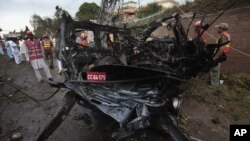
Local TV images from the city showed the flaming and smoking remains of a sports utility vehicle lying in the road.
Abdul Rahman who was working in a nearby clinic, described the blast.
“We were sitting in the clinic when we heard a loud blast," he says. "We thought that maybe it was a earthquake. All the windows and doors were damaged, but God saved us. We saw fire," he says, "and debris of the damaged car. I saw a dead person’s head.”
No-one immediately claimed responsibility for Monday’s bombing, but Peshawar is the capital of the northwestern province that borders Afghanistan, an area where Taliban and al-Qaida militants operate
But Retired Brigadier Asad Muneer, a defense analyst, said the latest attack was part of a pattern of violence by the Taliban in the area. He said Monday’s suicide bombing had been carefully planned.
“These people, they knew the place where these people were living, in the University Town, and they were carrying out reconnaissance, and they found a suitable target and they exploded a bomb,” he said.
He said the attacks were likely in response to Pakistan military operations in the region. Pakistan military posts and units also have been attacked.
Earlier, provincial information minister Mian Iftikar Hussain had said that two Americans had died in Monday’s explosion.
Peshawar has been the site of frequent bomb blasts. On Friday, a bomb targeting local officials killed at least 12 people and injured 20 more.
U.S. State Department spokeswoman Victoria Nuland Monday confirmed in a statement that Americans had been hit in the blast.
Referring to the statement, a spokeswoman for the U.S. embassy in Islamabad, Rian Harris, gave details of the early morning explosion.
“We can confirm that a vehicle belonging to the U.S. Consulate in Peshawar was hit in an apparent terrorist attack," said Harris. "Two U.S. personnel and two Pakistani staff of the Consulate were injured and are receiving medical treatment. No U.S. Consulate personnel were killed, but we are seeking further information about other victims of this heinous act.”
Some 19 people were injured in the blast, which took place in a crowded part of the city known as University Town. Several international organizations have their offices in the neighborhood.
Local TV images from the city showed the flaming and smoking remains of a sports utility vehicle lying in the road.
Abdul Rahman who was working in a nearby clinic, described the blast.
“We were sitting in the clinic when we heard a loud blast," he says. "We thought that maybe it was a earthquake. All the windows and doors were damaged, but God saved us. We saw fire," he says, "and debris of the damaged car. I saw a dead person’s head.”
No-one immediately claimed responsibility for Monday’s bombing, but Peshawar is the capital of the northwestern province that borders Afghanistan, an area where Taliban and al-Qaida militants operate
But Retired Brigadier Asad Muneer, a defense analyst, said the latest attack was part of a pattern of violence by the Taliban in the area. He said Monday’s suicide bombing had been carefully planned.
“These people, they knew the place where these people were living, in the University Town, and they were carrying out reconnaissance, and they found a suitable target and they exploded a bomb,” he said.
He said the attacks were likely in response to Pakistan military operations in the region. Pakistan military posts and units also have been attacked.
Earlier, provincial information minister Mian Iftikar Hussain had said that two Americans had died in Monday’s explosion.
Peshawar has been the site of frequent bomb blasts. On Friday, a bomb targeting local officials killed at least 12 people and injured 20 more.