


Pakistan has ordered the United States to move out of an airbase on its territory, after shutting down NATO's two main overland supply routes into Afghanistan. Popular anger is mounting in Pakistan after NATO's killing of 24 Pakistani military personnel in a cross-border airstrike Saturday.
American forces have been given 15 days to vacate the Shamsi airbase in southwestern Pakistan, where the U.S. sometimes lands unmanned drone aircraft used to attack militants on Pakistani territory.
Pakistan ordered the departure a day after choking off the two main land routes for moving nonlethal supplies to U.S.-led NATO forces in Afghanistan.
NATO Secretary-General Anders Fogh Rasmussen says Saturday's killing of 24 Pakistani soldiers by U.S. aircraft was a “tragic unintended accident.” He has told Pakistan's prime minister the attack was as “unacceptable and deplorable as the deaths of Afghan and international personnel.”
With a NATO investigation into the matter pending, Pakistan's Foreign Minister Hina Rabbani Khar telephoned U.S. Secretary of State Hillary Clinton to convey the “deep sense of rage” in Pakistan. She said the attack demonstrated “complete disregard for international law and human life, and... negates the progress made by the two countries on improving relations.” Clinton responded by saying she was deeply saddened, and promised to work with Pakistan on the issue.
Pakistan also is reexamining its decision to attend a major Afghanistan peace conference in Bonn next month, but has made no final announcement.
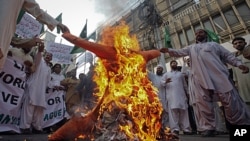
Retired Lieutenant General Talat Masood, an expert on Pakistan's strategic affairs, says the killings have dealt a severe blow to the already negative perceptions of the U.S. among Pakistanis.
“The majority of the people think that it was an aggression committed by the U.S. by design. The public sentiment has become very anti-American," Masood stated. "And, of course, it gives a big handle to the media to spread the nationalist frenzy.”
Pakistani television networks broadcast images of the soldiers' funerals Sunday. Soldiers' coffins were draped in the Pakistani flag and airlifted to their respective hometowns for burial.
Masood says a thorough and transparent investigation into why and how the airstrike took place may have a chance at soothing some of the anger in this country.
“I think if the investigation takes place in which Pakistan is taken into full confidence, and if the truth comes out that this was a gross miscalculation on the part of some of the intelligence people - and they apologize, and they compensate - I think it would make definitely a difference,” Masood said.
Al-Qaida leader Osama bin Laden used Afghanistan as a base to plan and execute the terror attacks of September 11, 2001. U.S. special forces killed bin Laden in a Pakistan compound earlier this year. U.S.-led NATO forces in Afghanistan have faced a constant challenge with the Pakistan border, which is frequently crossed by Pakistan-based militants.
Pakistan Orders US Out of Airbase