



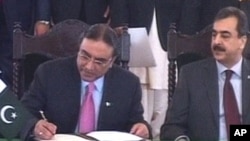
Pakistani President Asif Ali Zardari has signed into law a constitutional amendment that strips him of powers originally given to the presidency by the country's former military dictator two decades ago.
Pakistani President Asif Ali Zardai signed the 18th amendment in the presidential palace, during a ceremony that ranged from a solemn affair of gathered dignitaries to a raucous political rally.
Gathered in attendance were select members of Pakistani civil society, government officials, and the heads of the country's political parties, including opposition leader and outspoken rival of President Zardari, Nawaz Sharif.
Mr. Zardari's signature was the last step in formalizing the constitutional reforms, which both houses of the Pakistani Parliament passed unanimously earlier this month. After signing the bill, President Zardari referred back to 1973 when Pakistan's constitution was first created.
"It is my hope that the nation will once again be driven by a sense of purpose just as it was when the constitution was adopted," he said. "It is my hope that the doors of dictatorship have been closed forever."
In the 1980s, military ruler Mohammad Zia-ul-Haq assumed several powers to maintain control of the government, including the powers to dissolve parliament and appoint judges and the heads of the country's armed forces. These powers now go to the parliament and the office of the prime minister.
Prime Minister Yousuf Raza Gilani said with this reaffirmation of the country's democracy, the government now must continue its efforts in earnest to solve the problems affecting Pakistanis.
"The government is already making every effort to overcome an energy shortage, poverty, illiteracy, unemployment, inadequate health facilities, rural and the regional backwardness," he said.
But critics remain skeptical about the constitutional changes, saying political party heads, which include the current president, gain power. Opposition Senator and noted constitutional expert S.M. Zafar tells VOA party heads can now force their lawmakers to keep the party's line in several matters, including during a vote of no confidence for a prime minister.
"The direction of the political party has to be obeyed," he said. "And if not obeyed, then the matter can be referred to the election commission, who can disqualify the person concerned after a hearing."
There also has been much controversy regarding a clause of the amendment that renames the North West Frontier Province to Khyber Pakhtunkhwa. The new name reflects the Pashtun ethnic majority of the province, which predominately speaks Pashto. The province's Hindko-speaking population has been demonstrating against the name change in protests that at times have turned violent during the past few weeks. The protesters say they want the province's name to remain unchanged or they will demand a separate province that will reflect their majority in the south.
Prominent lawyers' groups also have rejected a provision in the amendment that empowers a parliamentary commission to approve or reject judges' nominations by the Supreme Court chief justice. Representatives for the groups say they will challenge the provision to get it reversed.
Related Report by VOA's Ravi Khanna