


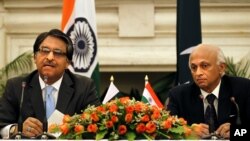
NEW DELHI — India and Pakistan have concluded two days of talks in the Indian capital vowing to persevere with the dialogue, despite their differences. Pakistan has rejected Indian allegations of involvement of its state agencies in the 2008 terror attacks in Mumbai.
Pakistani Foreign Secretary Jalil Abbas Jilani Thursday dismissed charges by India’s home minister that Pakistani “state actors” played a role in the multiple terror strikes attacks that devastated Mumbai in 2008.
Jilani says there is nothing to be gained by pointing a finger at each other.
“I would very strongly reject any insinuation of any involvement of any (Pakistani) state agency in acts of terrorism in India,” he said.
The Pakistani diplomat was speaking in New Delhi after holding two days of talks on issues spanning trade to terrorism with his Indian counterpart.
He offered help in investigating a key suspect in the Mumbai attacks, who was arrested last month. New Delhi says it has gathered evidence from Zabiuddin Ansari, also known as Abu Jundal, about how the attacks were coordinated from a control room in Karachi, Pakistan.
Indian Foreign Secretary Ranjan Mathai says that India wants Pakistan to pursue the leads that have emerged from Jundal’s interrogation and evidence given earlier.
“I emphasized that terrorism is the biggest threat to peace and security in the region and that bringing the guilty to justice in the Mumbai terror attacks would be the biggest confidence-building measure of all….The arrest and ongoing interrogation of Abu Jundal has now added urgency to this matter,” said Mathai.
India has long blamed Islamabad for dragging its feet in investigating and prosecuting people who allegedly played a role in the Mumbai terror attacks.
Despite the differences about the issue of terror, both countries sounded an optimistic note about the peace dialogue.
They say they want to take more steps to facilitate trade and travel across the Kashmir border and promote sporting and media contacts. They held discussions on the disputed territory, Kashmir, and said they will work to narrow divergences and promote convergence.
Indian Mathai said the dialogue is on a positive trajectory.
“We are cognizant that much more needs to be done… and that the path ahead is not going to be an easy one. But the very fact that both sides are determined to sit across the table and resolve all outstanding issues through a dialogue in a peaceful manner is a positive sign,” added Mathai.
Pakistani Jilani echoed the need to persevere with the dialogue and normalize ties.
“There should be absolutely no setback because setback is something we cannot afford,” he said.
The talks between the South Asian rivals were resumed last year after being put on hold for more than two years in the aftermath of the Mumbai attacks.
Pakistani Foreign Secretary Jalil Abbas Jilani Thursday dismissed charges by India’s home minister that Pakistani “state actors” played a role in the multiple terror strikes attacks that devastated Mumbai in 2008.
Jilani says there is nothing to be gained by pointing a finger at each other.
“I would very strongly reject any insinuation of any involvement of any (Pakistani) state agency in acts of terrorism in India,” he said.
The Pakistani diplomat was speaking in New Delhi after holding two days of talks on issues spanning trade to terrorism with his Indian counterpart.
He offered help in investigating a key suspect in the Mumbai attacks, who was arrested last month. New Delhi says it has gathered evidence from Zabiuddin Ansari, also known as Abu Jundal, about how the attacks were coordinated from a control room in Karachi, Pakistan.
Indian Foreign Secretary Ranjan Mathai says that India wants Pakistan to pursue the leads that have emerged from Jundal’s interrogation and evidence given earlier.
“I emphasized that terrorism is the biggest threat to peace and security in the region and that bringing the guilty to justice in the Mumbai terror attacks would be the biggest confidence-building measure of all….The arrest and ongoing interrogation of Abu Jundal has now added urgency to this matter,” said Mathai.
India has long blamed Islamabad for dragging its feet in investigating and prosecuting people who allegedly played a role in the Mumbai terror attacks.
Despite the differences about the issue of terror, both countries sounded an optimistic note about the peace dialogue.
They say they want to take more steps to facilitate trade and travel across the Kashmir border and promote sporting and media contacts. They held discussions on the disputed territory, Kashmir, and said they will work to narrow divergences and promote convergence.
Indian Mathai said the dialogue is on a positive trajectory.
“We are cognizant that much more needs to be done… and that the path ahead is not going to be an easy one. But the very fact that both sides are determined to sit across the table and resolve all outstanding issues through a dialogue in a peaceful manner is a positive sign,” added Mathai.
Pakistani Jilani echoed the need to persevere with the dialogue and normalize ties.
“There should be absolutely no setback because setback is something we cannot afford,” he said.
The talks between the South Asian rivals were resumed last year after being put on hold for more than two years in the aftermath of the Mumbai attacks.