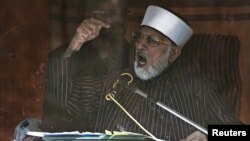
Sufi cleric and leader of the Minhaj-ul-Quran religious organisation Muhammad Tahirul Qadri addresses his supporters from behind the window of an armored vehicle on the second day of protests in Islamabad, January 15, 2013.
Tahir-ul Qadri returned to a hero's welcome in Pakistan in December, attracting thousands with calls for reforms ahead of this year's elections.
What is Qadri's background?
The 62-year-old Sufi cleric first emerged on Pakistan's political scene some three decades ago, when General Muhammad Zia-ul Haq was in power. During that time, Qadri made a name for himself as a legal adviser on Islamic law for both the country's Supreme Court and the Federal Sharia Court of Pakistan.
In 1981, he founded Minhaj-ul-Quran, an educational, spiritual and humanitarian non-governmental agency that now has branches in more than 90 countries. Qadri later went on to create the political party Pakistan Awami Tehreek.
In 2002, he won a seat in Pakistan's National Assembly under General Pervez Musharraf's rule. However, he resigned two years later, condemning Pakistan's political system as corrupt. He then moved to Canada, where he became a Canadian citizen and continued his religious activities.
What are his beliefs?
Qadri preaches a philosophy that promotes merging modernist views with Islam and encouraging Muslims in Western countries to become fully integrated with those societies. He achieved some international fame in 2010 with his fatwa - or religious opinion - condemning terrorism.
According to his group's website, Minhaj-ul-Quran's goals include promoting peace, tolerance, interfaith harmony, education, integration, community cohesion, and women's rights; engaging with young Muslims for religious moderation; and providing social welfare.
What does he want?
Qadri returned to a hero's welcome in Pakistan in December with his message that there must be reforms ahead of this year's elections. Analysts say this call struck a chord with average Pakistanis, who are upset with a status quo that includes electricity blackouts, a sluggish economy and a decade-long fight against domestic Taliban militants.
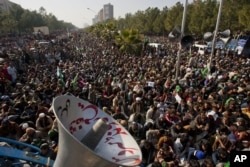
Supporters of cleric Tahir-ul Qadri listen to his speech at an anti-government rally in Islamabad, Pakistan, January 15, 2013.
The cleric and former politician is calling for the dissolution of the current government and for early elections. His most controversial demand has been for the military to play a role in picking an interim government that would take over ahead of the vote and could stay in charge longer than normal in order to implement reforms.
Why does he face opposition?
It is his call for the military to participate in the election that has left many in the political establishment worried. For the first time in Pakistan's history, the country is poised to have a peaceful handover of power from one civilian government to another. But Qadri's demand for military involvement, as well as his ties to the Zia- and Musharraf-era governments, have led critics to accuse him of being a military puppet.
However, experts say it is still too early to tell if Qadri is a viable threat to Pakistan's political establishment. While he has drawn crowds in the thousands, it is still nowhere near the "millions" of protesters he has promised. Also, his Canadian citizenship prevents him from running for office in Pakistan.