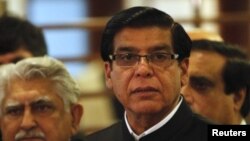
The head of Pakistan's anti-corruption bureau says it has decided not to arrest Prime Minister Raja Pervez Ashraf, despite orders to do so by the supreme court.
Fasih Bokhari, chief of the National Accountability Bureau, told the court Thursday that he does not have sufficient evidence to arrest Ashraf on corruption charges.
On Tuesday, the Supreme Court ordered the arrest of the prime minister and 15 others on charges related to a scandal involving private power stations.
Ashraf is accused of taking bribes for arranging to build power plants to serve Pakistan's power deficiency. He has denied the allegations.
Also Thursday, Muslim cleric Tahir-ul Qadri said this is the last day his supporters will conduct a sit-in at the parliament building in Islamabad, where they have been calling for the government to dissolve.
He demanded talks with President Asif Ali Zardari and said if he does not get them, he and his followers will change strategies on Friday. He did not elaborate.
Pakistan is due to hold parliamentary elections in mid-May, and parliament would be dissolved about two months beforehand. But Qadri is calling on the government to step down immediately, to clear the way for an interim Cabinet to root out graft and mismanagement. He blames those shortcomings for chronic energy shortages, slow economic growth and a rise in crime and the Taliban insurgency.
Fasih Bokhari, chief of the National Accountability Bureau, told the court Thursday that he does not have sufficient evidence to arrest Ashraf on corruption charges.
On Tuesday, the Supreme Court ordered the arrest of the prime minister and 15 others on charges related to a scandal involving private power stations.
Raja Pervez Ashraf
Raja Pervez Ashraf- Born in 1950 in Sindh province
- Water and power minister from 2008 to 2011
- Under Investigation for taking kickbacks, which he denies
- Information technology minister in 2011 to 2012
- Elected as prime minister June 22, 2012
Also Thursday, Muslim cleric Tahir-ul Qadri said this is the last day his supporters will conduct a sit-in at the parliament building in Islamabad, where they have been calling for the government to dissolve.
He demanded talks with President Asif Ali Zardari and said if he does not get them, he and his followers will change strategies on Friday. He did not elaborate.
Pakistan is due to hold parliamentary elections in mid-May, and parliament would be dissolved about two months beforehand. But Qadri is calling on the government to step down immediately, to clear the way for an interim Cabinet to root out graft and mismanagement. He blames those shortcomings for chronic energy shortages, slow economic growth and a rise in crime and the Taliban insurgency.