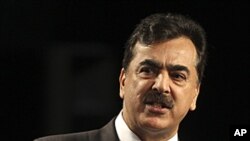



Amid growing tensions between Pakistan's government and the country's powerful military, Prime Minister Yousuf Raza Gilani is appealing for support from parliament.
Pakistan’s increasingly unpopular coalition government and Prime Minister Gilani have lately come under intense pressure from opposition parties as well as army generals for issues such as allegedly poor governance and a controversial memo seeking foreign help to rein in the military.
Addressing parliament on Friday, the Pakistani prime minister largely rejected criticism of his government’s performance, and denied it is on a path of confrontation with the military.
Gilani did acknowledged political leaderships are prone to mistakes, but that errors of judgment should not be used to penalize parliament or the democratic system. He was referring to suggestions that a military coup could be a possible outcome of the ongoing tensions between civilian government ministers and army leaders.
The prime minister says now is the time for politicians to decide whether they want democracy or dictatorship in Pakistan.
Current tensions between Pakistan's powerful military and the civilian government stem from a controversial memo that became public last year - an unsigned note that sought U.S. help to prevent a military coup in Islamabad. The memo was delivered to the U.S military last year shortly after an American raid killed Osama bin Laden in his hideout in a Pakistani garrison city.
Prime Minister Gilani and President Asif Ali Zardari, chief of the ruling party, both have denied any link to the memo. A Supreme Court-appointed judicial commission is investigating the document's origin, authenticity and purpose.
Gilani told lawmakers Friday that regardless of the outcome of the probe, democracy must survive in Pakistan, where the military has ruled for about half of the country’s 64-year history.
The prime minister later addressed a ceremony in the eastern city of Lahore to reiterate his support for democracy.
“The people of Pakistan have now learned a lesson from our own history, that democracy is not easy but it is the only viable option," said Gilani. "Democracies are noisy, reflect power tussles and highlight internal conflicts. But it is only through democracy that we can work together to forge national unity.”
While the government rejects the memo as a non-issue, army chief General Ashfaq Parvez Kayani has stated before the Supreme Court that the document is a reality.
Most analysts in Pakistan believe the military leadership does not want a coup. However, analyst Rasool Bakhsh Rais, a professor of political science, notes that military circles are unhappy with Zardari and Gilani.
“Actually the national climate today is against military interventions, and all the political parties in Pakistan have agreement on constitutional democracy. I think that there is a possibility that not the government is going to be overthrown but the head of the state and head of the government, Asif Ali Zardari and Yousuf Raza Gilani, may be declared unfit to hold office,” Rais said.
If Pakistan's judicial inquiry establishes a link between the memo and the government, that could lead to the impeachment of President Zardari and the removal of Prime Minister Gilani’s Cabinet. Top leaders of the ruling Pakistan People’s Party contend the military is working with the Supreme Court to seek a "constitutional" dismissal of the government.
Pakistan's PM Appeals for Support Amid Tensions