



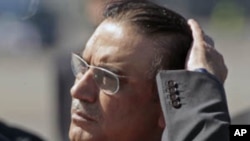
Pakistani President Asif Ali Zardari has met with the country's army chief for talks, amid rising tensions between Pakistan's civilian government and its powerful military that threaten to destablize the country's weak civilian government.
Pakistani officials say Zardari held talks Saturday with army chief General Ashfaq Parvez Kayani to discuss the security situation in the country. Officials gave no other details on the meeting.
Later Saturday, General Kayani and Pakistani Prime Minister Yousuf Raza Gilani attended a meeting before the government's defense committee.
In an apparent effort to defuse tensions, Gilani said at the meeting that Pakistan's government and parliament have stood fully behind the military. He also said Pakistan's sovereignty and territorial integrity are non-negotiable.
Tensions between the government and military stem from an unsigned memo that allegedly sought U.S. help to prevent a military coup in Pakistan.
Pakistan's Supreme Court is investigating the memo, which was allegedly sent by a Pakistani official to the U.S. military last year.
A few days ago, Gilani fired Pakistan's defense secretary for his role in submitting statements to the Supreme Court made by two top security officials.
Gilani also accused the two officials, army chief Kayani and Inter-Services Intelligence head Lieutenant General Ahmad Shuja Pasha, of acting unlawfully by making unilateral submissions to the Supreme Court inquiry.
Those remarks prompted Pakistan's military to warn of "grievous consequences" for the country.
A Supreme Court-appointed panel is probing the origins of the unsigned memo in which Pakistan's civilian government asked for U.S. help in reining in the Pakistani military following the U.S. raid that killed Osama bin Laden last May.
The existence of the memo surfaced in October when Pakistani-American businessman Mansoor Ijaz accused the then-Pakistani ambassador to the U.S., Husain Haqqani, of writing the memo. Haqqani denies writing the document and has since resigned.
The army has ruled Pakistan for most of its existence since independence from Britain in 1947. There have been three military coups in Pakistan, and no civilian government has ever completed its term in office.
Some information for this report was provided by AP, AFP and Reuters.