News / Middle East

Abbas Receives Hero's Welcome in West Bank

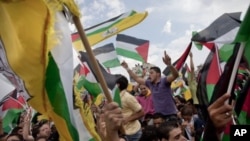
Palestinians dance and sing prior to the arrival of Palestinian President Mahmoud Abbas at the government compound, in the West Bank city of Ramallah, September 25, 2011.
TEXT SIZE - +
Robert Berger

The leader of the Palestinians is getting a popularity boost after submitting a bid for statehood at the United Nations. But peacemaking with Israel is in limbo.

Palestinian President Mahmoud Abbas got a hero's welcome in the West Bank, two days after asking the United Nations to recognize a Palestinian state. He was greeted by thousands of cheering and flag-waving Palestinians.

Referring to the revolutions in Middle Eastern countries that have been dubbed the "Arab Spring," Mr. Abbas declared that "the Palestinian Spring has begun!"

He said the Palestinians want to attain their rights through peaceful means, and he vowed that despite a long road ahead with many obstacles, they would achieve their goal of an independent state.

Mr. Abbas has been widely praised by his people for pushing ahead with the statehood bid, despite fierce opposition from the United States and Israel, who say Palestinian independence and peace can only be achieved through negotiations.

The Palestinian leader told the crowd that while he supports peace talks, he would not return to the negotiating table until Israel stops all settlement construction in the West Bank and East Jerusalem.

On Saturday, Mr. Abbas rejected an international proposal for renewing peace talks because it did not include two key conditions: a settlement freeze and Israeli recognition of a Palestinian state based on the pre-war 1967 borders.

The Quartet of Middle East mediators - the U.S., European Union, United Nations and Russia - submitted the proposal on Friday, hours after Mr. Abbas requested U.N. membership from the Security Council, despite threats of a U.S. veto. The Quartet called for a resumption of peace talks in a month, and a framework peace agreement on Palestinian statehood by the end of 2012.

Israel has welcomed the proposal for resuming direct talks.

Foreign Minister Avigdor Lieberman told Israel Radio that the proposal is positive because there are no preconditions. Israel says freezing settlements and recognizing a Palestinian state on territory Israel captured in the 1967 war would determine the outcome of negotiations before they begin.


Follow our Middle East reports on Twitter
and discuss them on our Facebook page.

You May Like

Experts Weigh In on Challenges of Closing Guantanamo Prison

Former chief military prosecutor at Guantanamo delivers petition to White House with more than 370,000 signatures, demanding facility be closed down immediately More

Karzai to Discuss Enhancing Defense Ties with India

Afghanistan looking for more military aid as it prepares for withdrawal of NATO forces by next year More

India, China Pledge to Overcome Border Tensions

Indian prime minister and Chinese premier attempt to move past tense standoff in the Himalayas during Delhi talks More

Burmese President Opens US Visit with VOA Town Hall Meeting

Ahead of his meeting with President Obama Monday, Thein Sein answered questions on human rights and economic development in his country More

This forum has been closed.
Comments
     
There are no comments in this forum. Be first and add one

Featured Videos

Your JavaScript is turned off or you have an old version of Adobe's Flash Player. Get the latest Flash player.
Video

Video US Oil Surge Could Impact Mideast Geopolitics

The United States will account for a third of new oil supplies over the next five years, and will become energy self-sufficient in 20 years, according to a new report by the Paris-based International Energy Agency (IEA). Although U.S. oil imports from Arab Gulf countries increased last year, analysts predict the U.S. will lose its dependence on Middle East imports, which is expected to have a huge impact on international relations and the balance of power. VOA's Henry Ridgewell reports.