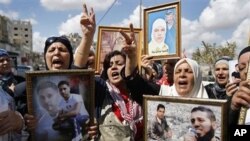
Hundreds of Palestinian prisoners in Israeli jails have agreed to end a weeks-long hunger strike in exchange for promises of better conditions, averting fears of widespread unrest if any of the inmates had died.
Israel Prisons Service spokeswoman Sivan Weizman confirmed late Monday that a deal had been reached. Egypt and Jordan played key roles in mediating between the Israelis and prison leaders representing all Palestinian factions.
The Palestinians won key concessions, including more family visits and limits to a controversial Israeli policy that can imprison people for years without charge.
The agreement also saw roughly 20 prisoners released from solitary confinement back into the general prison population. These include Hamas member Abdullah al-Barghouthi, serving 67 life sentences for helping to plan a series of suicide bombings that killed scores of civilians.
In return, Israel extracted pledges by militant groups "to prevent terror activities," and averted the potentially explosive scenario of prisoners dying in a hunger strike.
Israel's Shin Bet security agency said Monday the prisoners committed themselves to stop helping plan and conduct attacks from inside Israeli jails through networks that enable contact with the outside world. It said renewed violence or resumed prisoner strikes would "annul the Israeli commitment."
Both sides were eager to reach an agreement before Tuesday, when Palestinians have planned mass demonstrations to commemorate a day they call the "nakba," or catastrophe, of Israel's 1948 declaration of independence.
The hunger strike garnered widespread support among Palestinians, with hundreds joining daily marches and sit-in protests.
Outside mediation was necessary because many of the striking prisoners were associated with groups that Israel has no direct contact with, including Hamas, which refuses to recognize Israel, and the even more militant Islamic Jihad.
The mass action was sparked by Khader Adnan, an Islamic Jihad spokesman who fasted for 66 days this year to demand his release from incarceration without charge. He ended his fast after Israeli authorities agreed to release him a few weeks early.
The two longest strikers, Bilal Diab and Thaer Halahleh, have said they would not start eating again until their administrative detentions are lifted. They have survived by occasionally taking infusions of nutrients. Both are Islamic Jihad members.
Palestinian Authority President Mahmoud Abbas said last week the death of a hunger striker could be “disastrous,” triggering a backlash that could lead to the collapse of the West Bank's security system.
Israel Prisons Service spokeswoman Sivan Weizman confirmed late Monday that a deal had been reached. Egypt and Jordan played key roles in mediating between the Israelis and prison leaders representing all Palestinian factions.
The Palestinians won key concessions, including more family visits and limits to a controversial Israeli policy that can imprison people for years without charge.
The agreement also saw roughly 20 prisoners released from solitary confinement back into the general prison population. These include Hamas member Abdullah al-Barghouthi, serving 67 life sentences for helping to plan a series of suicide bombings that killed scores of civilians.
In return, Israel extracted pledges by militant groups "to prevent terror activities," and averted the potentially explosive scenario of prisoners dying in a hunger strike.
Israel's Shin Bet security agency said Monday the prisoners committed themselves to stop helping plan and conduct attacks from inside Israeli jails through networks that enable contact with the outside world. It said renewed violence or resumed prisoner strikes would "annul the Israeli commitment."
Both sides were eager to reach an agreement before Tuesday, when Palestinians have planned mass demonstrations to commemorate a day they call the "nakba," or catastrophe, of Israel's 1948 declaration of independence.
The hunger strike garnered widespread support among Palestinians, with hundreds joining daily marches and sit-in protests.
Outside mediation was necessary because many of the striking prisoners were associated with groups that Israel has no direct contact with, including Hamas, which refuses to recognize Israel, and the even more militant Islamic Jihad.
The mass action was sparked by Khader Adnan, an Islamic Jihad spokesman who fasted for 66 days this year to demand his release from incarceration without charge. He ended his fast after Israeli authorities agreed to release him a few weeks early.
The two longest strikers, Bilal Diab and Thaer Halahleh, have said they would not start eating again until their administrative detentions are lifted. They have survived by occasionally taking infusions of nutrients. Both are Islamic Jihad members.
Palestinian Authority President Mahmoud Abbas said last week the death of a hunger striker could be “disastrous,” triggering a backlash that could lead to the collapse of the West Bank's security system.