


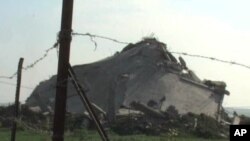
It has been a year since Israel launched Operation Cast Lead, a 22-day ground offensive in the Gaza Strip. Palestinian leaders and human rights groups say the assault killed 1,400 Palestinians. Israel says 1,166 Palestinians died, along with 13 Israelis. The objective was to stop militants in Gaza from launching the rockets that had terrorized communities in southern Israel for years.
The memory of the violence is fresh for Faraj Soumani, 23. He says he watched Israeli soldiers kill his father.
"He raised his hands," he said. "Then, the Israeli soldiers started shooting straight at him. They shot him first on his shoulder than at his head. Then they started shooting all over his body."
The family's home was destroyed. Its main breadwinner was dead.
In all, 29 members of the Samouni clan were killed in Israel's offensive.
Recovery has not been easy despite international donations. Faraj's mother, Zahwe, was left to fend for herself and the children.
"We got a little compensation money and help from good people," she said. "I tried to rebuild, but discovered that my husband had some debts I had to repay. I paid off as much as I could."
Zahwe Samouni had little cash left and was unable to find enough construction materials, but she managed to build a two-room cinderblock house.
"Almost all the time, we have only bread and herbs to eat, and tea. But thank God, we have a roof to live under. That is the most important thing - that we are living in a house," she added.
For the people in the neighboring Israeli town of Sderot, the offensive brought some relief.
"I can tell you it's more quiet over here, and the people over here feel safer," said Liat Biton, a Sderot resident.
The number of rockets from Gaza falling on the town has dropped sharply since the war.
Residents say they are sleeping better.
But if Sderot residents are enjoying the relative peace, some fear it may not last.
"To have a long term solution, you need both sides to be ready to compromise," she added. "And as I can see right now, that's not the situation."
To lift the blockade, Israel demands that Hamas release captured soldier Gilad Shalit. It also wants a guarantee from Hamas that militants will not use construction materials to build bunkers and weapons to attack Israel.
With his home in ruins, his father dead, and his family hungry, Faraj Samouni says he believes it is time to negotiate a solution.
"If there is an agreement, it will be a good thing for the people here, because in this time we have become dead," she explained. "Everyone is half-dead. It does not matter if you shell them because you are shelling a dead body."
In exchange for Shalit, Hamas wants Israel to release thousands of Palestinian prisoners.
One year after the war, a lasting solution remains only a wish.