


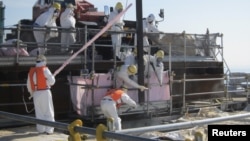
TOKYO — An investigative panel has concluded the last of a series of high-profile reviews of last year’s accident at the Fukushima Daiichi nuclear power plant. The report criticizes actions by the plant’s operator, the government and industry regulators.
The 12 members of a panel appointed by the Japanese Cabinet interviewed 770 people in the past year. They include government officials, Tokyo Electric Power Company employees and some of the 160,000 residents forced to evacuate their homes.
Panel chairperson, Yotaro Hatamura, says the Fukushima accident illustrates the results of Japan’s reliance on what he calls the myth of nuclear safety.
In a reference to last year’s tsunami, initially described by the plant’s operator as an “unforeseen threat,” Hatamura urges authorities to remain humble towards any potential risk and to prepare for the worst.
The report says Japan’s main regulatory body, the Nuclear and Industrial Safety Agency, was too confident in the nuclear plant's ability to withstand a severe accident. It says this sort of attitude prevented the agency from adopting a pro-active stance on safety issues.
The panel members also focus on the government’s response to the Fukushima accident, saying important decisions were missed because officials spent too much time micro-managing the situation. Authorities are accused of misleading the public by suppressing, and later denying, the possibility of a meltdown.
One member of the panel urged all concerned parties to look beyond individual responsibilities and to see the accident as the product of a flawed system. The investigators underline that much more needs to be done to understand what exactly happened at Fukushima Daiichi.
The 12 members of a panel appointed by the Japanese Cabinet interviewed 770 people in the past year. They include government officials, Tokyo Electric Power Company employees and some of the 160,000 residents forced to evacuate their homes.
Panel chairperson, Yotaro Hatamura, says the Fukushima accident illustrates the results of Japan’s reliance on what he calls the myth of nuclear safety.
In a reference to last year’s tsunami, initially described by the plant’s operator as an “unforeseen threat,” Hatamura urges authorities to remain humble towards any potential risk and to prepare for the worst.
The report says Japan’s main regulatory body, the Nuclear and Industrial Safety Agency, was too confident in the nuclear plant's ability to withstand a severe accident. It says this sort of attitude prevented the agency from adopting a pro-active stance on safety issues.
The panel members also focus on the government’s response to the Fukushima accident, saying important decisions were missed because officials spent too much time micro-managing the situation. Authorities are accused of misleading the public by suppressing, and later denying, the possibility of a meltdown.
One member of the panel urged all concerned parties to look beyond individual responsibilities and to see the accident as the product of a flawed system. The investigators underline that much more needs to be done to understand what exactly happened at Fukushima Daiichi.