



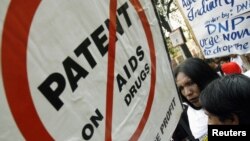
NEW DELHI — A long running legal battle in India over drug patents could impact access to affordable, lifesaving drugs to millions of people across the globe.
The case is being seen as a high stakes battle between drug companies supporting intellectual property rights and those who favor the production of cheap, generic drugs.
Dr. Suniti Solomon has treated thousands of men and women suffering from HIV at her clinic in the southern city of Chennai since she detected India’s first AIDS infection 25 years ago. Affordable copies of brand name drugs produced by India’s booming generic drug industry have helped her patients enormously.
“Earlier, when we did not have generic drugs, maybe one or two percent of my patients could afford the drugs from abroad," Solomon said. "Now, 60 to 70 percent can easily afford at least the first line drugs which keep them alive for maybe ten years or longer.”
Like the patients in Chennai, these generic drugs are a lifeline for millions of people in Africa and other developing countries.
Many of them are not aware of it, but a case pending before the Indian Supreme Court could have a far reaching impact on their access to these inexpensive drugs.
It involves a legal challenge by Swiss pharmaceutical company Novartis to India’s refusal to grant a patent for a medicine used to treat leukemia. It has been winding its way through the Indian courts for almost six years. Final arguments will be heard next month.
India denied a patent for Gleevec saying that it is not a new medicine but a salt formulation of a known drug. India does not allow companies to patent modifications of an old medicine unless its efficacy is significantly improved.
Forty countries, including the United States, China and Russia, have granted a patent for Gleevec. But in India, its generic version is being produced at a fraction of the cost.
Novartis says it is seeking clarity on how innovation by the drug industry will be protected in India. Ranjit Shahani, who heads the India operations of Novartis, says inadequate patent protection will discourage innovators.
“The long road to innovation research is fraught with risks and huge costs," Shahani said. "Only one out of ten thousand experimental compounds in development will reach the marketplace and the cost is between one to two billion dollars for each medicine approved. A successful molecule that makes it as a drug needs to pay for thousands of those molecules that fail.”
The case has attracted international attention. The multinational drug industry sees the Indian law as a way of circumventing patent rights and wants more stringent standards.
However, supporters of India’s patent law say that it prevents a practice called “evergreening,” in which drug companies get new patents by making minor changes to older ones and stave off generic competition.
Leena Menghaney, a lawyer with Doctors Without Borders in New Delhi, calls it a test case.
“If Novartis wins, it can have a huge chilling effect on generic production. Once patenting standards are lowered, that means more patents are granted on drugs, that means less number of drugs generic companies will be able to manufacture. So it has implications across the board for all essential medicines, particularly for HIV,” Mengheny said.
Health activists fear that a ruling in favor of Novartis may drastically reduce the global supply of inexpensive, generic drugs being used to treat people suffering from deadly diseases. They say if costs rise greatly, voluntary groups across the world will have to significantly scale down programs assisting patients who cannot afford lifesaving medicines.
One such patient is a 23-year-old student in Mumbai, Siddhesh Tilekar. Since he was diagnosed with cancer about three years ago, he gets drugs from a local cancer support group.
“We cannot afford that much of cost," Tilekar said. "If my family spends on my medicine, it is very difficult for us to survive.”
Multinational drug companies are worried about other provisions in India’s patent law.
Earlier this year, India allowed a domestic company to manufacture an expensive anti-cancer drug developed by Bayer Corporation using a rule under which a license can be granted if a drug is not available at a “reasonably affordable price.”
According to Ranjit Shahani at Novartis, protecting patents is critical.
“The reality is without patents there will be no new drugs and without new drugs there will be no generics," he said. "So if innovation is not protected, it is the patient who will be the ultimate loser.”
Lawyers say there are also worries that India’s patent laws could become a model for other developing countries, limiting the multinational drug industry’s access to these fast-growing markets.
The case is being seen as a high stakes battle between drug companies supporting intellectual property rights and those who favor the production of cheap, generic drugs.
Dr. Suniti Solomon has treated thousands of men and women suffering from HIV at her clinic in the southern city of Chennai since she detected India’s first AIDS infection 25 years ago. Affordable copies of brand name drugs produced by India’s booming generic drug industry have helped her patients enormously.
“Earlier, when we did not have generic drugs, maybe one or two percent of my patients could afford the drugs from abroad," Solomon said. "Now, 60 to 70 percent can easily afford at least the first line drugs which keep them alive for maybe ten years or longer.”
Like the patients in Chennai, these generic drugs are a lifeline for millions of people in Africa and other developing countries.
Many of them are not aware of it, but a case pending before the Indian Supreme Court could have a far reaching impact on their access to these inexpensive drugs.
It involves a legal challenge by Swiss pharmaceutical company Novartis to India’s refusal to grant a patent for a medicine used to treat leukemia. It has been winding its way through the Indian courts for almost six years. Final arguments will be heard next month.
India denied a patent for Gleevec saying that it is not a new medicine but a salt formulation of a known drug. India does not allow companies to patent modifications of an old medicine unless its efficacy is significantly improved.
Forty countries, including the United States, China and Russia, have granted a patent for Gleevec. But in India, its generic version is being produced at a fraction of the cost.
Novartis says it is seeking clarity on how innovation by the drug industry will be protected in India. Ranjit Shahani, who heads the India operations of Novartis, says inadequate patent protection will discourage innovators.
“The long road to innovation research is fraught with risks and huge costs," Shahani said. "Only one out of ten thousand experimental compounds in development will reach the marketplace and the cost is between one to two billion dollars for each medicine approved. A successful molecule that makes it as a drug needs to pay for thousands of those molecules that fail.”
The case has attracted international attention. The multinational drug industry sees the Indian law as a way of circumventing patent rights and wants more stringent standards.
However, supporters of India’s patent law say that it prevents a practice called “evergreening,” in which drug companies get new patents by making minor changes to older ones and stave off generic competition.
Leena Menghaney, a lawyer with Doctors Without Borders in New Delhi, calls it a test case.
“If Novartis wins, it can have a huge chilling effect on generic production. Once patenting standards are lowered, that means more patents are granted on drugs, that means less number of drugs generic companies will be able to manufacture. So it has implications across the board for all essential medicines, particularly for HIV,” Mengheny said.
Health activists fear that a ruling in favor of Novartis may drastically reduce the global supply of inexpensive, generic drugs being used to treat people suffering from deadly diseases. They say if costs rise greatly, voluntary groups across the world will have to significantly scale down programs assisting patients who cannot afford lifesaving medicines.
One such patient is a 23-year-old student in Mumbai, Siddhesh Tilekar. Since he was diagnosed with cancer about three years ago, he gets drugs from a local cancer support group.
“We cannot afford that much of cost," Tilekar said. "If my family spends on my medicine, it is very difficult for us to survive.”
Multinational drug companies are worried about other provisions in India’s patent law.
Earlier this year, India allowed a domestic company to manufacture an expensive anti-cancer drug developed by Bayer Corporation using a rule under which a license can be granted if a drug is not available at a “reasonably affordable price.”
According to Ranjit Shahani at Novartis, protecting patents is critical.
“The reality is without patents there will be no new drugs and without new drugs there will be no generics," he said. "So if innovation is not protected, it is the patient who will be the ultimate loser.”
Lawyers say there are also worries that India’s patent laws could become a model for other developing countries, limiting the multinational drug industry’s access to these fast-growing markets.