



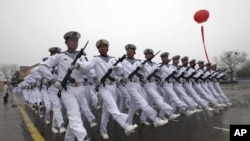
A new Pentagon report says China is steadily building its military and expanding its capabilities to operate far from its shores.
In its annual report to Congress, the U.S. Defense Department says China's military budget continues to grow as Beijing modernizes its military to eventually be able to carry out what the Beijing government calls "new historic missions," which could include some in places far beyond China's shores.
David Helvey, an acting deputy assistant secretary of defense for East Asia security, told reporters Friday China is investing in newer and better weapons, missile defense systems, submarines, an aircraft carrier and development of a stealth fighter jet.
"This comprehensive military modernization is supported by robust increases in defense resources. On March 4th of this year, Beijing announced an 11.2 percent increase in its military budget, raising its publicized budget to $106 billion, continuing more than two decades of sustained military budget growth," Helvey said.
U.S. defense officials estimate China's non-publicized military spending was as high as $180 billion last year.
The U.S. Defense Department report says China is using technology from airplanes and other equipment it buys from the West to develop its military capabilities. The report calls China one of the world’s most active and persistent perpetrators of economic espionage.
The report says China's military focus is for now set on Taiwan. But it also points to operations such as the evacuation of Chinese nationals from Libya, counter piracy efforts in the Gulf of Aden, and humanitarian missions in Latin America as indicators of the Chinese military's ambitions to reach farther.
U.S. officials stopped short of voicing concern over the modernization of China's armed forces, known formally as the People's Liberation Army, or PLA. Delvey says that, along with the potential challenges, there is an opportunity for China to be a positive force for stability.
"We see the PLA adapting to these missions and looking at ways to operate farther and farther from China. We see an opportunity to be able to work with China as they are adapting to these new missions. We see that as China has greater capacity and capability to operate at distances from China that it has a responsibility also to uphold international norms and rules and to support the international community’s interests in peace and stability," Delvey said.
Thomas Hammes, a retired Marine colonel who has written on the topic of future warfare, says the Obama administration's decision to pivot its focus to the Asia Pacific region is a positive move. He says what is missing now is a strategy for how to deal with any potential threat from China.
"There's been no discussion of a strategy if we have a conflict with China. First off, a conflict with China is extraordinarily unlikely. Let's agree on that. Also agree on the fact that there is no limit to the infinite capacity for stupidity of the human race. So, while it's a really bad idea, you have to be prepared in case it happens," Hammes said.
Analysts say indications are that China wants to avoid conflict in the near future.
The Pentagon report notes steps Beijing has taken to ease troubled relations with Japan and confidence-building measures it is taking with its Southeast Asian neighbors in the region with whom it has ongoing territorial disputes.
In its annual report to Congress, the U.S. Defense Department says China's military budget continues to grow as Beijing modernizes its military to eventually be able to carry out what the Beijing government calls "new historic missions," which could include some in places far beyond China's shores.
David Helvey, an acting deputy assistant secretary of defense for East Asia security, told reporters Friday China is investing in newer and better weapons, missile defense systems, submarines, an aircraft carrier and development of a stealth fighter jet.
"This comprehensive military modernization is supported by robust increases in defense resources. On March 4th of this year, Beijing announced an 11.2 percent increase in its military budget, raising its publicized budget to $106 billion, continuing more than two decades of sustained military budget growth," Helvey said.
U.S. defense officials estimate China's non-publicized military spending was as high as $180 billion last year.
The U.S. Defense Department report says China is using technology from airplanes and other equipment it buys from the West to develop its military capabilities. The report calls China one of the world’s most active and persistent perpetrators of economic espionage.
The report says China's military focus is for now set on Taiwan. But it also points to operations such as the evacuation of Chinese nationals from Libya, counter piracy efforts in the Gulf of Aden, and humanitarian missions in Latin America as indicators of the Chinese military's ambitions to reach farther.
U.S. officials stopped short of voicing concern over the modernization of China's armed forces, known formally as the People's Liberation Army, or PLA. Delvey says that, along with the potential challenges, there is an opportunity for China to be a positive force for stability.
"We see the PLA adapting to these missions and looking at ways to operate farther and farther from China. We see an opportunity to be able to work with China as they are adapting to these new missions. We see that as China has greater capacity and capability to operate at distances from China that it has a responsibility also to uphold international norms and rules and to support the international community’s interests in peace and stability," Delvey said.
Thomas Hammes, a retired Marine colonel who has written on the topic of future warfare, says the Obama administration's decision to pivot its focus to the Asia Pacific region is a positive move. He says what is missing now is a strategy for how to deal with any potential threat from China.
"There's been no discussion of a strategy if we have a conflict with China. First off, a conflict with China is extraordinarily unlikely. Let's agree on that. Also agree on the fact that there is no limit to the infinite capacity for stupidity of the human race. So, while it's a really bad idea, you have to be prepared in case it happens," Hammes said.
Analysts say indications are that China wants to avoid conflict in the near future.
The Pentagon report notes steps Beijing has taken to ease troubled relations with Japan and confidence-building measures it is taking with its Southeast Asian neighbors in the region with whom it has ongoing territorial disputes.