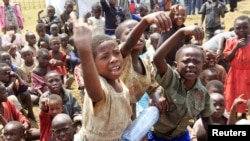
Humanitarian agencies said they are deeply concerned over the deteriorating situation in the North Kivu province of the Democratic Republic of Congo. Fighting between different breakaway groups of soldiers from the national army and government soldiers have forced thousands of families to flee from their homes in the area for safety.
Yvon Edoumou of the United Nations Office for the Coordination of Humanitarian Affairs, OCHA, Kinshasa, said while the fighting on the one hand is between the national army and a group of breakaway soldiers, on the other hand you also have a number of armed groups that are going about causing insecurity in North Kivu.
“Basically, all these incidents are directly pushing people to be displaced, or people are preventively moving to stay safe before fighting breaks out. The fighting in North Kivu is quite volatile. It has been so since April and over the past two weeks it has in a sense taken a downturn,” said Edoumou.
Edoumou said OCHA is still in the process of assessing an accurate number of those affected. He said since the beginning of July 2012 there have been incidents in Rutshuru Territory and Walikale Centre causing people to move in various directions, including into Rwanda and Uganda.
“All in all, since April, we estimate as many as 250,000 people have been displaced by the fighting in North Kivu,” said Edoumou.
The humanitarian worker said the fighting is having a direct impact on humanitarian agencies being able to provide assistance in the area because it is restricting their ability to move around.
“About 60 humanitarian workers had to be relocated from Walikale because of fighting,” said Edoumou.
In addition to restrictions on the ability to provide supplies and food, aid agencies are also concerned that their ability to provide protection from child recruitment and sexual violence is also being hindered.
Yvon Edoumou of the United Nations Office for the Coordination of Humanitarian Affairs, OCHA, Kinshasa, said while the fighting on the one hand is between the national army and a group of breakaway soldiers, on the other hand you also have a number of armed groups that are going about causing insecurity in North Kivu.
“Basically, all these incidents are directly pushing people to be displaced, or people are preventively moving to stay safe before fighting breaks out. The fighting in North Kivu is quite volatile. It has been so since April and over the past two weeks it has in a sense taken a downturn,” said Edoumou.
Edoumou said OCHA is still in the process of assessing an accurate number of those affected. He said since the beginning of July 2012 there have been incidents in Rutshuru Territory and Walikale Centre causing people to move in various directions, including into Rwanda and Uganda.
“All in all, since April, we estimate as many as 250,000 people have been displaced by the fighting in North Kivu,” said Edoumou.
The humanitarian worker said the fighting is having a direct impact on humanitarian agencies being able to provide assistance in the area because it is restricting their ability to move around.
“About 60 humanitarian workers had to be relocated from Walikale because of fighting,” said Edoumou.
In addition to restrictions on the ability to provide supplies and food, aid agencies are also concerned that their ability to provide protection from child recruitment and sexual violence is also being hindered.