


PEPFAR, the President’s Emergency Plan for AIDS Relief, is responsible for getting millions of people on treatment. But researchers say it was not until the program started using cheaper generic drugs that great strides were made against the epidemic.
PEPFAR is considered one of the hallmarks of President George W. Bush’s time in office. Its goal was to transform HIV/AIDS from a death sentence into a manageable chronic disease. And for millions of people around the world, that’s now the case as the program continues under President Obama.
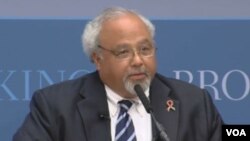
However, Dr. Kartik Venkatesh said when PEPFAR began it was hampered by the high cost of brand name antiretroviral drugs.
“Early on, PEPFAR wasn’t able to reach nearly as many individuals because if the proprietary versions of these drugs were going to be used, simply, with the limited budget only so many could be reached. However, [in] the real success of PEPFAR, a significant factor has been the procurement and use of generic drugs,” he said.
Venkatesh is the lead author of a study by Brown University researchers on the success of PEPFAR.
He said, “The question was if we’re providing patented drugs to American patients, we should be providing the same drugs internationally to HIV-infected patients because it’s U.S. taxpayer dollars. One could say there were multiple reasons why that was the case. Certainly some would also speculate that the pharmaceutical industry did have a vested interest perhaps. But in the end it was a matter of that these generic drugs were known to work.”
And they were known to work about the time PEPFAR was launched in 2003. Using generics dropped PEPFAR’s cost of treating a person from about $1,100 per year to about $300 in 2005.
“Both the U.S. government and American taxpayers are getting more bang for their buck. And [for] a lot of developing countries, that certainly means more money gets to be spent on other healthcare services, other than just putting money into treatment and drugs,” said Venkatesh.
PEPFAR has also been able to save millions of dollars by reducing transport costs – using ships instead of planes to deliver the drugs.
The PEPFAR model, said Venkatesh, could also be applied to other diseases as developing countries begin seeing what had been mostly rich nation diseases.
“There is a move towards understanding that the real and perhaps potentially larger burden in the future is also going to be chronic diseases like cardiovascular diseases, diabetes, cancer. And those are also diseases that require chronic, long-term medication. A lot can be learned from the experience about accessing generics for the treatment of HIV,” he said.
The Brown University study recommended that a regulatory framework be in place for the “efficient and transparent procurement of generic drugs.” This would include the U.S. government, the Food and Drug Administration, the World Health Organization and generic drug manufacturers.
PEPFAR is considered one of the hallmarks of President George W. Bush’s time in office. Its goal was to transform HIV/AIDS from a death sentence into a manageable chronic disease. And for millions of people around the world, that’s now the case as the program continues under President Obama.
However, Dr. Kartik Venkatesh said when PEPFAR began it was hampered by the high cost of brand name antiretroviral drugs.
“Early on, PEPFAR wasn’t able to reach nearly as many individuals because if the proprietary versions of these drugs were going to be used, simply, with the limited budget only so many could be reached. However, [in] the real success of PEPFAR, a significant factor has been the procurement and use of generic drugs,” he said.
Venkatesh is the lead author of a study by Brown University researchers on the success of PEPFAR.
He said, “The question was if we’re providing patented drugs to American patients, we should be providing the same drugs internationally to HIV-infected patients because it’s U.S. taxpayer dollars. One could say there were multiple reasons why that was the case. Certainly some would also speculate that the pharmaceutical industry did have a vested interest perhaps. But in the end it was a matter of that these generic drugs were known to work.”
And they were known to work about the time PEPFAR was launched in 2003. Using generics dropped PEPFAR’s cost of treating a person from about $1,100 per year to about $300 in 2005.
“Both the U.S. government and American taxpayers are getting more bang for their buck. And [for] a lot of developing countries, that certainly means more money gets to be spent on other healthcare services, other than just putting money into treatment and drugs,” said Venkatesh.
PEPFAR has also been able to save millions of dollars by reducing transport costs – using ships instead of planes to deliver the drugs.
The PEPFAR model, said Venkatesh, could also be applied to other diseases as developing countries begin seeing what had been mostly rich nation diseases.
“There is a move towards understanding that the real and perhaps potentially larger burden in the future is also going to be chronic diseases like cardiovascular diseases, diabetes, cancer. And those are also diseases that require chronic, long-term medication. A lot can be learned from the experience about accessing generics for the treatment of HIV,” he said.
The Brown University study recommended that a regulatory framework be in place for the “efficient and transparent procurement of generic drugs.” This would include the U.S. government, the Food and Drug Administration, the World Health Organization and generic drug manufacturers.