
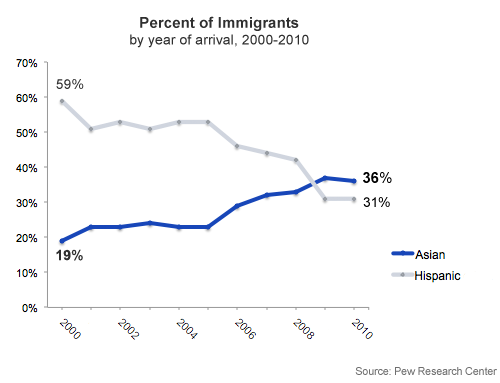
A new study says Asian Americans have overtaken Hispanics as the largest group of new immigrants arriving in the United States each year.
The report released Tuesday by the Pew Research Center, a U.S.-based fact-finding organization, also found that Asian Americans are the "highest-income, best-educated and fastest growing racial group in the United States."
The study, The Rise of Asian Americans, found that Asians living in the U.S. are more likely than the general public to be satisfied with their lives, finances and the direction of the country.
Cary Funk, a senior researcher for the report, said various factors are influencing Asians to immigrate to the United States, including employment and educational opportunities.
“Generally, it’s a mix of reasons," she said. "One of the most common reasons for immigration is for family reunification, but it’s usually a mix of employment and education and family reasons that Asians, as well as other immigrants, are coming to the U.S.”
The study cited a rise in Asian Americans from less than one percent of the U.S. population in 1965 to 5.8 percent today. Funk called that increase "striking," but she could not pinpoint how high it will go in the future.
"Part of that rise has to do with the change in our immigration policies in 1965, so that opened the immigration stream from all parts of the world," she said. "What we’re seeing from Asian Americans, keep in mind, is that they are a majority immigrant group, [with] 74 percent of Asian American adults [being] foreign-born. Of course there’s some variation across sub-groups of Asians, but of the six largest U.S. Asian groups, Japanese Americans are majority U.S.-born, and the other five are majority foreign-born.”
Asians are coming to the United States from dozens of countries in the Far East, Southeast Asia and the Indian subcontinent.
While Asian immigration to the U.S. has increased only slightly in recent years, the survey said Asians have become the new face of U.S. immigration largely because of a sharp decline in Hispanic immigrants.
About 430,000 Asians, or 36 percent of all new immigrants, arrived in the U.S. in 2010, as compared with about 370,000, or 31 percent, who were Hispanic.
According to the Pew Research Center, Asian immigrants are more likely than some other groups to arrive legally in the United States. It said up to 15 percent of Asian immigrants are in the U.S. illegally, compared to 45 percent of Hispanic immigrants.
The comprehensive survey, based on interviews with more than 3,500 Asian Americans, also found that Asians in the U.S. place more value than other Americans on marriage, parenthood, hard work, and career success.
It said more than six-in-ten adults who have come from Asia in recent years have at least a bachelor's degree, saying this "almost surely makes the recent Asian arrivals the most highly educated cohort of immigrants in U.S. history."
The report released Tuesday by the Pew Research Center, a U.S.-based fact-finding organization, also found that Asian Americans are the "highest-income, best-educated and fastest growing racial group in the United States."
The study, The Rise of Asian Americans, found that Asians living in the U.S. are more likely than the general public to be satisfied with their lives, finances and the direction of the country.
Cary Funk, a senior researcher for the report, said various factors are influencing Asians to immigrate to the United States, including employment and educational opportunities.
“Generally, it’s a mix of reasons," she said. "One of the most common reasons for immigration is for family reunification, but it’s usually a mix of employment and education and family reasons that Asians, as well as other immigrants, are coming to the U.S.”
The study cited a rise in Asian Americans from less than one percent of the U.S. population in 1965 to 5.8 percent today. Funk called that increase "striking," but she could not pinpoint how high it will go in the future.
"Part of that rise has to do with the change in our immigration policies in 1965, so that opened the immigration stream from all parts of the world," she said. "What we’re seeing from Asian Americans, keep in mind, is that they are a majority immigrant group, [with] 74 percent of Asian American adults [being] foreign-born. Of course there’s some variation across sub-groups of Asians, but of the six largest U.S. Asian groups, Japanese Americans are majority U.S.-born, and the other five are majority foreign-born.”
Asians are coming to the United States from dozens of countries in the Far East, Southeast Asia and the Indian subcontinent.
While Asian immigration to the U.S. has increased only slightly in recent years, the survey said Asians have become the new face of U.S. immigration largely because of a sharp decline in Hispanic immigrants.
About 430,000 Asians, or 36 percent of all new immigrants, arrived in the U.S. in 2010, as compared with about 370,000, or 31 percent, who were Hispanic.
According to the Pew Research Center, Asian immigrants are more likely than some other groups to arrive legally in the United States. It said up to 15 percent of Asian immigrants are in the U.S. illegally, compared to 45 percent of Hispanic immigrants.
The comprehensive survey, based on interviews with more than 3,500 Asian Americans, also found that Asians in the U.S. place more value than other Americans on marriage, parenthood, hard work, and career success.
It said more than six-in-ten adults who have come from Asia in recent years have at least a bachelor's degree, saying this "almost surely makes the recent Asian arrivals the most highly educated cohort of immigrants in U.S. history."