



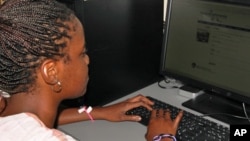
The United Nations recently declared Internet access to be a human right. But in the United States, as in many other countries, millions of people do not have access to the wealth of information found online. In Philadelphia, communities are responding to narrow the digital divide.
Seven-year-old Lonnette Wiley frowns in concentration as she maneuvers her mouse to zigzag a white arrow across her computer screen. With one finger, she carefully types the name of one of her favorite websites.
She likes to email her dad, talk to friends on Facebook and is learning to do research online.
“Sometimes my teacher will ask me questions," she says, "and then I will search them on Google.”
But last year, the second grader struggled to do Internet homework. The only computer she could use was at a local library, which usually closed two hours after school ended. Lonnette is still learning where all the letters are on the keyboard, so she never had enough time to finish.
Lonnette currently lives with her mother at the People’s Emergency Center in Philadelphia. It serves as a transitional residence for homeless single women and their children. The dozens of families it serves had no in-house computer access until last week, when the city opened a computer lab in the center.
Living in the digital dark ages made it difficult for children to do homework and for moms, like Florence Delbridge, to learn computer skills or find a job.
“Never had access to a computer so I’m learning," says Delbridge. "I’m also in computer classes and like to learn all I can, because I never had the opportunity to.”
Philadelphia city officials estimate 41 percent of residents cannot afford computers or to pay for Internet access. But Mayor Michael Nutter plans to change that.
“You can't truly be free if you don't have information," he says. "You can’t truly be connected if you have no ability to be connected.”
Nutter has added technology improvements to Philadelphia’s most recent infrastructure plan, which typically maps out future transportation and utility systems, housing developments and public buildings. Experts, like Andrew Buss, from the city’s division of technology, say that’s a vital step in closing the digital divide.
“It’s kind of a new mindset that technology has to be viewed across the city’s infrastructure and it’s a very important part of it,” says Buss.
So important that, over the next two years, Philadelphia plans to set up 48 computer centers - like the one at the People’s Emergency Center - in other shelters, recreation centers and libraries.
It will also distribute more than 5,000 laptops to low-income families and create public wifi spots for free wireless Internet access. The project will bring the city closer to digital equality. That's an important goal, according to Nicol Turner Lee, director of the Media and Technology Institute for the Joint Center for Political and Economic Studies.
“What started out as a digital divide, where at that time we were dealing with public access to computers and the Internet, has turned into a movement to advance digital inclusion and digital equality," says Lee, "that allows citizens to really realize the full benefit of how this tool and platform can improve the quality of their life.”
Computer labs are a great way to bring access to low-income families, but Lee says she would like to see cities invest in projects that bring the Internet directly into homes
“The ability to accelerate in home broadband access allows people to have this unlimited connection to a resource that will change their lives and transform their lives. That’s really the ideal place to have citizens connected: where they live.”
Other U.S. cities are also taking steps to close the digital divide. San Francisco's mayor hopes to provide the entire city with free or low cost Internet access. Minneapolis participates in a Computer Exchange Program that gives refurbished computers to low income families. And smaller communities, like Binghamton, New York, focus on teaching digital literacy skills to children and the unemployed.