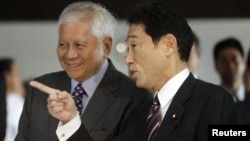
Japanese Foreign Minister Fumio Kishida (R) talks to Philippine Foreign Affairs Secretary Albert del Rosario in Manila, January 10, 2013.
Japan and the Philippines pledged to increase their maritime cooperation in the face of territorial disputes with China, an outcome of Japanese Foreign Minister Fumio Kishida’s visit to the Philippines.
Philippine Foreign Secretary Albert del Rosario said after meetings with Kishida that the two shared “mutual concern” over developments in the South China Sea, according to the Philippine ABS-CBN news outlet.
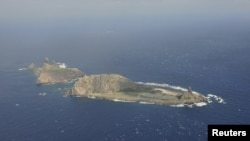
Handout photograph shows the disputed islets, known as Senkaku in Japan and Diaoyu in China, Dec. 13, 2012.
China and the Philippines both lay claim the Spratly Islands, where there are rich fisheries and possible oil and gas reserves. Japan is locked into a tense showdown with China over the Senkaku/Diaoyu Islands in the East China Sea.
"On the political and security front, we agreed on strengthening policy dialogue, enhancing maritime cooperation and other measures," Kishida told reporters at a joint press conference.
Kishida went on to say that the security environment in the Asia-Pacific region is changing, making it important to enhance the strategic partnership between the two countries.
Numerous news outlets have reported that Japan is considering giving the Philippines 10 maritime patrol vessels, which could be delivered as early as 18 months from now.
Click to enlarge
Del Rosario said Japan has already helped the Philippine coast guard through human resource development, and has also helped augment its communications systems.
ABS-CBN reported that del Rosario reiterated that the Philippines is still seeking a peaceful resolution to its territorial disputes with China and will continue to do so through political, diplomatic and legal tracks.
According to Allen Carlson, an associate professor of government at Cornell University, it is not surprising that Japan and the Philippines, which have the most contentious disputes with China, would choose to come together to “represent rather direct displeasure with Beijing’s handling of maritime issues in the region.”
China’s Asian neighbors have traditionally been “hedging their bets” and trying to maintain good relations with both Washington and Beijing, Carlson said, but some have recently become less cautious.
“Over the past several years, as tensions in Asia have escalated, some have begun to stake out a less nuanced approach, choosing to take actions that are designed to balance against what is perceived as increased Chinese assertiveness, particularly in regard to territorial disputes,” he said.
“This being said, the current commitment to enhance cooperation between Tokyo and Manilla seems largely symbolic, and is unlikely to have any substantive impact on either country's disputes with China,” he said.
Kishida and del Rosario also discussed increasing trade and tourism, and Kishida announced loans for two infrastructure projects in the Philippines.
Kishida’s first trip since being appointed foreign minister in Shinzo Abe’s cabinet also includes stops in Singapore, Brunei and Australia.