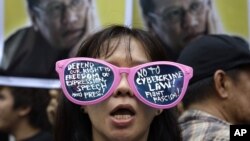
The Philippines Supreme Court has suspended a controversial new cybercrime law that critics say infringes on free speech.
Justice Secretary Leila de Lima said Tuesday the court issued a temporary restraining order, keeping the law from taking effect until it can review whether certain provisions limit civil liberties.
The law, which went into force last week, targets identity theft, hacking and child pornography, among other offenses. But critics have taken particular issue with a provision that gives heavy punishment for online libel. They also fear a clause that allows the government to shut down websites and monitor online activity without a court order.
Human Rights Watch's Asia director Brad Adams said the court's suspension was not enough, urging it to strike down what he called the "seriously flawed" law.
Under the law, anything considered libelous and posted online comes with a possible prison sentence of up to 12 years. This more than doubles the punishment for the same offense carried out on paper.
It also gives the Secretary of Justice powers to block or restrict access to Internet data that she determines violates the law.
Justice Secretary de Lima has questioned the need for some parts of the law. She said the inclusion of cyber libel is not necessary because there is already a criminal libel law under the country’s penal code.
Many human rights groups, journalists and Internet users have protested the law by replacing their profile pictures on social media websites with black screens. Hackers have also targeted several government websites in protest.
Justice Secretary Leila de Lima said Tuesday the court issued a temporary restraining order, keeping the law from taking effect until it can review whether certain provisions limit civil liberties.
The law, which went into force last week, targets identity theft, hacking and child pornography, among other offenses. But critics have taken particular issue with a provision that gives heavy punishment for online libel. They also fear a clause that allows the government to shut down websites and monitor online activity without a court order.
Human Rights Watch's Asia director Brad Adams said the court's suspension was not enough, urging it to strike down what he called the "seriously flawed" law.
Under the law, anything considered libelous and posted online comes with a possible prison sentence of up to 12 years. This more than doubles the punishment for the same offense carried out on paper.
It also gives the Secretary of Justice powers to block or restrict access to Internet data that she determines violates the law.
Justice Secretary de Lima has questioned the need for some parts of the law. She said the inclusion of cyber libel is not necessary because there is already a criminal libel law under the country’s penal code.
Many human rights groups, journalists and Internet users have protested the law by replacing their profile pictures on social media websites with black screens. Hackers have also targeted several government websites in protest.