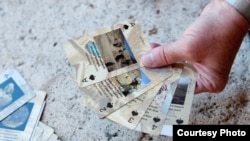
Archeological playing cards, created by US Army archeologist Dr. Laurie Rush and her colleagues, help troops recognize and respect the cultural heritage in the countries where they’re deployed. (Photo by Luigi Fraboni)
AMELIA, Italy — Laurie Rush is on a mission. The American scientist is teaching the U.S. military about the value of archeological sites and ancient artifacts in combat zones.
Rush joined forces with the U.S. military in 1998, when she accepted a civilian post as an archeologist at Fort Drum, New York. The area is rich in Native American history, Rush’s specialty, and part of her job is to ensure that construction and training on the vast base don’t harm any valuable archeological sites.
That’s what happened in the ancient Iraqi city of Babylon in 2003 following the U.S.-led invasion. As American and Polish troops were building a camp, they inadvertently crushed an ancient brick pavement and destroyed dragon decorations on the Ishtar Gate, which was constructed at around 575 BC.
“My participation, and the entire change in my own personal career, came with learning that there had been damage at Babylon," Rush says. "It immediately occurred to me that a better educated force would not have made those kinds of mistakes.”
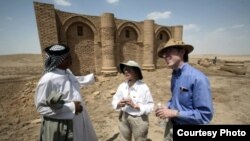
Laurie Rush and colleague Brian Rose at the ancient city of Uruk in Iraq, talking with Mr. Altubi, head of the family that protects the site. (Courtesy Laurie Rush)
In collaboration with Colorado State University, Rush designed a simple but effective training tool for U.S. troops: playing cards. Three different decks of cards were produced, with versions displaying photos and messages about the cultural heritage of Iraq, Afghanistan and Egypt.
When they sent out queries to base archeologists and deploying units to see if anyone wanted the cards, the requests poured in. The U.S. National Guard distributed many of the 165,000 decks in circulation. Troops from more than 10 countries made use of the Egyptian decks during training exercises there.
Each playing card has a different image: pictures of Buddhist statues, tablets, and ancient brick walls. There are also reminders that buying and selling antiquities is illegal, and instructions to ”Look before you dig!” Rush says troops passing the hours with poker games have absorbed the messages.
“There is a tiny site at a forward operating base east of Baghdad. It’s a Mesopotamian city site," Rush says. "And I got an email from a soldier and he said, ‘Dr. Rush, I think that they’re digging into archeological property here at this forward operating base.’”
Rush immediately notified the base commander. The 1954 Hague Convention, signed by more than 100 countries, requires the protection of cultural heritage in war zones.
“And as a result, the ‘Keep Out’ signs went up that afternoon," Rush says. "So there’s a tiny [historical] place that is still there.”
In the ancient Italian city of Amelia, Rush spoke at the conference of the Association for Research into Crimes against Art. She says troops at first express impatience when hearing her pleas for preservation in conflict zones.
“Soldiers will often say, ‘Dr. Rush, if what you’re suggesting is going to result in losses of my personnel, don’t even think about it,’” Rush says.
However, the troops are more receptive once she explains how the destruction of cultural property could interfere with their mission.
"One of the examples that comes to mind is situations in Afghanistan where U.S. military personnel might not recognize that those piles of stone by the side of the road with a little flag is a burial of a recently deceased family member," she says. "If you run over that with your military vehicle, you’re going to understandably anger the Afghans.”
On the other hand, she notes, respect for historical sites has helped foster trust and good will between the military and the locals, as happened in the ancient city of Ur.
“The Americans had protected Ur during the early phases when all the looting was taking place in the southern part of Iraq," she says. "By 2009, the situation had stabilized so it was time to give it back to the Iraqi people.”
Rush and some colleagues went to Ur and reassured the installation commander that it was the proper step to take.
“It was going to be a good news story, that they had taken excellent care of the site and it was ready to be returned to the Iraqi people," she says. "So a month later, there was a huge celebration and over 300 Iraqi people came to celebrate the return of their ancient city. So that was an extraordinary life experience.”
Rush believes simulations of heritage protection must be incorporated into troop training. At Fort Drum, troops use mock Middle Eastern archeological sites for realistic exercises, a model which has been duplicated on other bases.
Some veterans, inspired by what Rush opened their eyes to, are studying to become archeologists. She hopes they’ll become soldier-preservationists who will support the military mission while also fostering respect for cultural heritage - a winning hand for all concerned.