


News / Europe

Police Clash With Anti-EU Protesters in Croatia

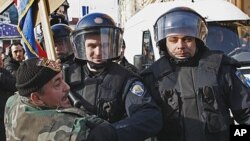
Croatian police push back an anti-EU protester attempting to remove an EU flag from the central square in Zagreb Saturday, January 21, 2012.
TEXT SIZE - +

Police in Croatia's capital clashed with nationalist protesters Saturday, on the eve of a crucial vote on the country's membership in the European Union.

About 1,000 protesters, many of them independence war veterans, gathered in Zagreb's central square, carrying banners saying "No to EU'' or "I love Croatia,'' and chanting anti-EU slogans. Using loudspeakers, activists demanded postponement of the vote, arguing that political leaders had failed to explain to citizens all that the EU entry entails.

Police arrested several protesters who tried to take down an EU flag from a pole, while others chanted "Treason! Treason!"  News reports say a few people were injured during the clashes.
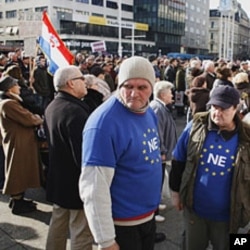
Croatian anti-EU protesters rally in the central square of Zagreb Saturday, January 21, 2012.

On Sunday, Croatian voters will say "yes" or "no" to the question: "Do you support the membership of the Republic of Croatia in the European Union?'' Between 50 and 60 percent of the voters are expected to vote yes.

Croatia has gone through an arduous six-year negotiating process with the EU before signing an accession treaty last year. It is set to join the 27-nation bloc in July 2013.

But in recent years, a growing number of Croatian citizens have grown disillusioned with the union and many believe there is nothing to be gained by joining, while they say some hard-earned independence may be lost.

Opponents of the accession singled out Foreign Minister Vesna Pusic as the main target of their criticism. Pusic has been one of Croatia's main negotiators in the entry talks and has said that postponing the referendum could have disastrous consequences for the country's economy.

Croatia is faced with serious economic problems, including unemployment at around 17 percent and a budget gap, projected at more than 6 percent of its gross domestic product.

In addition to the referendum, the accession treaty has to be ratified by all 27 member states before Croatia can enter the bloc.

Of the six former Yugoslav republics, only Slovenia is an EU member, having entered the grouping in 2004.  

Some information for this report was provided by AP and AFP.

You May Like

Experts Weigh In on Challenges of Closing Guantanamo Prison

Former chief military prosecutor at Guantanamo delivers petition to White House with more than 370,000 signatures, demanding facility be closed down immediately More

Karzai to Discuss Enhancing Defense Ties with India

Afghanistan looking for more military aid as it prepares for withdrawal of NATO forces by next year More

India, China Pledge to Overcome Border Tensions

Indian prime minister and Chinese premier attempt to move past tense standoff in the Himalayas during Delhi talks More

Burmese President Opens US Visit with VOA Town Hall Meeting

Ahead of his meeting with President Obama Monday, Thein Sein answered questions on human rights and economic development in his country More

This forum has been closed.
Comments
     
There are no comments in this forum. Be first and add one

Featured Videos

Your JavaScript is turned off or you have an old version of Adobe's Flash Player. Get the latest Flash player.
Video

Video US Oil Surge Could Impact Mideast Geopolitics

The United States will account for a third of new oil supplies over the next five years, and will become energy self-sufficient in 20 years, according to a new report by the Paris-based International Energy Agency (IEA). Although U.S. oil imports from Arab Gulf countries increased last year, analysts predict the U.S. will lose its dependence on Middle East imports, which is expected to have a huge impact on international relations and the balance of power. VOA's Henry Ridgewell reports.