


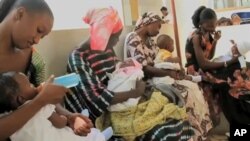
Fertility rates as well as future projected population growth are much higher in Africa than in any other part of the world. A new report by a Kenyan-based organization says that in some African countries, political will, maternal and child health concerns as well as more and more funding are helping to develop effective family planning. ,
Family planning, which aims to regulate the number of children women have, can range from using natural methods to higher use of contraceptives to, more controversially, relying on abortions.
The Nairobi-based African Institute for Development Policy presented a report called "Africa on the Move!" Tuesday in Washington at the Woodrow Wilson International Center for Scholars. The subtitle of the report was "The Role of Political Will and Commitment in Improving Access to Family Planning in Africa."
One of the authors, Violet Murunga, said having a country's top leadership champion the cause of family planning is essential. She mentioned the important role President Paul Kagame has played in Rwanda.
"He talks about family planning in public events, and in addition to that, because family planning is entrenched in the governance system, because it is included as a national development priority," said Murunga.
In recent years, the report notes contraceptive use among married women in Rwanda has risen from about 17 percent to over 50 percent, while fertility rates have fallen.
Top Rwandan government officials say curbing population growth is important to ensuring the country's continued economic development.
Another country where fertility rates have been dropping is Ethiopia. The government there has tied family planning promotion to reducing high maternal and child mortality rates.
Murunga also noted that Malawi's government has for the first time included family planning in its budget, even though the practice was once officially banned in the southern African country. She said it is important for governments to start not only talking about family planning, but also spending on programs for actual implementation.
"Governments could invest a lot more than they are in family planning and reproductive health programs," she said. "There is an over-reliance on donor funds, but it is changing. African governments are now starting to see the benefits of actually providing more and more funding."
Steve McDonald, the host of the event and Africa director at the Wilson Center, said partnerships between governments and religious organizations, which sometimes provide the bulk of health services in remote areas, are also crucial. He pointed out Rwanda's example, where in some cases family planning health posts have been placed next to Catholic clinics, even if they promote different methods of family planning.
"Obviously, if they just began setting up services for family planning and ignoring the Catholic church leadership, then it would have been setting the stage for a real battle there," said McDonald. "Instead they engage, they allow them to have their own counseling services, and they have the service for family planning next door, so that everybody agrees on it and no one fights over it."
Catholic clerics and other religious leaders in Africa oppose the use of contraceptives and abortions to limit family sizes.
Panelists said other challenges included the very young age at which girls marry in countries such as Niger, where the fertility rate is still estimated to be over seven births per woman.
Across the Sahel and throughout West and Central Africa, where there has been much less political will on the issue, fertility rates usually remain above six births per woman. Panelists said some politicians view population growth as a way of ensuring their countries' clout [influence] in international organizations.
However, surveys indicate a majority of Africans want to be able to better control the size of their families.
By the end of this century, the United Nations estimates that Africa's share of the global population will increase from 12 percent to about one-third. The U.N. projects the current world population of more than 7 billion people will rise above 10 billion by 2100.
Family planning, which aims to regulate the number of children women have, can range from using natural methods to higher use of contraceptives to, more controversially, relying on abortions.
The Nairobi-based African Institute for Development Policy presented a report called "Africa on the Move!" Tuesday in Washington at the Woodrow Wilson International Center for Scholars. The subtitle of the report was "The Role of Political Will and Commitment in Improving Access to Family Planning in Africa."
One of the authors, Violet Murunga, said having a country's top leadership champion the cause of family planning is essential. She mentioned the important role President Paul Kagame has played in Rwanda.
"He talks about family planning in public events, and in addition to that, because family planning is entrenched in the governance system, because it is included as a national development priority," said Murunga.
In recent years, the report notes contraceptive use among married women in Rwanda has risen from about 17 percent to over 50 percent, while fertility rates have fallen.
Top Rwandan government officials say curbing population growth is important to ensuring the country's continued economic development.
Another country where fertility rates have been dropping is Ethiopia. The government there has tied family planning promotion to reducing high maternal and child mortality rates.
Murunga also noted that Malawi's government has for the first time included family planning in its budget, even though the practice was once officially banned in the southern African country. She said it is important for governments to start not only talking about family planning, but also spending on programs for actual implementation.
"Governments could invest a lot more than they are in family planning and reproductive health programs," she said. "There is an over-reliance on donor funds, but it is changing. African governments are now starting to see the benefits of actually providing more and more funding."
Steve McDonald, the host of the event and Africa director at the Wilson Center, said partnerships between governments and religious organizations, which sometimes provide the bulk of health services in remote areas, are also crucial. He pointed out Rwanda's example, where in some cases family planning health posts have been placed next to Catholic clinics, even if they promote different methods of family planning.
"Obviously, if they just began setting up services for family planning and ignoring the Catholic church leadership, then it would have been setting the stage for a real battle there," said McDonald. "Instead they engage, they allow them to have their own counseling services, and they have the service for family planning next door, so that everybody agrees on it and no one fights over it."
Catholic clerics and other religious leaders in Africa oppose the use of contraceptives and abortions to limit family sizes.
Panelists said other challenges included the very young age at which girls marry in countries such as Niger, where the fertility rate is still estimated to be over seven births per woman.
Across the Sahel and throughout West and Central Africa, where there has been much less political will on the issue, fertility rates usually remain above six births per woman. Panelists said some politicians view population growth as a way of ensuring their countries' clout [influence] in international organizations.
However, surveys indicate a majority of Africans want to be able to better control the size of their families.
By the end of this century, the United Nations estimates that Africa's share of the global population will increase from 12 percent to about one-third. The U.N. projects the current world population of more than 7 billion people will rise above 10 billion by 2100.