


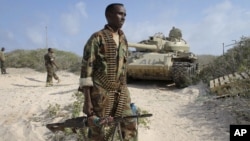
NAIROBI, Kenya — For months, the media have used words like “looming” and “imminent” to describe a long-anticipated, concerted military assault on Somalia's coastal city of Kismayo, the last remaining stronghold of militant group al-Shabab, and the financial hub for its operation.
Somali government forces and African Union (AU) troops are currently positioned in Miido, a village 80 kilometers west of Kismayo. But clan rivalry and political wrangling my be hindering operations to capture the city, analysts say.
The AU force in Somalia, known as AMISOM, has repeatedly expressed plans to liberate the city from the insurgents and Kenyan and Ethiopian troops have also been approaching the city.
Abdirashid Hashi, of the Brussels-based International Crisis Group, notes ground troops can move in if there is a political mechanism in place.
“I think the number one reason is a political issue, Hashi said. "I think if they don’t have a consensus amongst those actors and stake holders, I think it could backfire, it could create a problem for African Union forces. So I think its very important to have some sort of political understanding, what will happen next, the morning after they got to Kismayo."
On the political front, sources familiar with political talks going on behind the scenes say that one of the key issues major clans agree on is to make Kismayo a business city, but not the capital of a proposed new state in and around Kismayo called Jubaland.
But where should the capital of Jubaland will be?
Members of the Marehan clan are suggesting Bardhere in the Gedo region and members of the Ogaden clan want Buale to be the capital.
Ahmed Madobe the head of the Ras Kamboni faction, aligned with the government forces and AU troops in their fight against al-Shabab, says his group wants to see an inclusive federal state no matter where the capital is located.
He says in the political meetings they want to move away from clan divisions and want people to identify themselves with the regions, cities, districts and villages they hail from and not to identify themselves with their clans.
Jubaland would consist of three regions, Gedo, Middle and Lower Juba. The three regions consist of 15 districts. How to share the positions and what clan should get what territory is another problem.
Abdirashid Hashi says there is the need to organize some sort of temporary administration to govern Kismayo itself before the city is taken.
“They shouldn’t go to Kismayo unless they have a plan who will administer the city and who will provide service to the people," he said. "They need services and its very important. You know this is not fighting over spoils of war; these are human beings, they have needs.”
Hashi also stressed that the national government has to be involved in the process so that people stop saying this is a foreign process led by Kenya and Ethiopia.
Somalia is in the process of ending an eight-year political transition to establish the first stable central government since 1991. The government already has its hands full negotiating power between the various federal states that make up Somalia, which may one day include Jubaland.
Somali government forces and African Union (AU) troops are currently positioned in Miido, a village 80 kilometers west of Kismayo. But clan rivalry and political wrangling my be hindering operations to capture the city, analysts say.
The AU force in Somalia, known as AMISOM, has repeatedly expressed plans to liberate the city from the insurgents and Kenyan and Ethiopian troops have also been approaching the city.
Abdirashid Hashi, of the Brussels-based International Crisis Group, notes ground troops can move in if there is a political mechanism in place.
“I think the number one reason is a political issue, Hashi said. "I think if they don’t have a consensus amongst those actors and stake holders, I think it could backfire, it could create a problem for African Union forces. So I think its very important to have some sort of political understanding, what will happen next, the morning after they got to Kismayo."
On the political front, sources familiar with political talks going on behind the scenes say that one of the key issues major clans agree on is to make Kismayo a business city, but not the capital of a proposed new state in and around Kismayo called Jubaland.
But where should the capital of Jubaland will be?
Members of the Marehan clan are suggesting Bardhere in the Gedo region and members of the Ogaden clan want Buale to be the capital.
Ahmed Madobe the head of the Ras Kamboni faction, aligned with the government forces and AU troops in their fight against al-Shabab, says his group wants to see an inclusive federal state no matter where the capital is located.
He says in the political meetings they want to move away from clan divisions and want people to identify themselves with the regions, cities, districts and villages they hail from and not to identify themselves with their clans.
Jubaland would consist of three regions, Gedo, Middle and Lower Juba. The three regions consist of 15 districts. How to share the positions and what clan should get what territory is another problem.
Abdirashid Hashi says there is the need to organize some sort of temporary administration to govern Kismayo itself before the city is taken.
“They shouldn’t go to Kismayo unless they have a plan who will administer the city and who will provide service to the people," he said. "They need services and its very important. You know this is not fighting over spoils of war; these are human beings, they have needs.”
Hashi also stressed that the national government has to be involved in the process so that people stop saying this is a foreign process led by Kenya and Ethiopia.
Somalia is in the process of ending an eight-year political transition to establish the first stable central government since 1991. The government already has its hands full negotiating power between the various federal states that make up Somalia, which may one day include Jubaland.