



Polls in recent years show that fewer Americans believe global warming is a threat or that it is driven by human activities.
That’s despite consensus among scientists that climate change is not only very real, but also that it is caused largely by the burning of fossil fuels in cars, trucks and power plants.
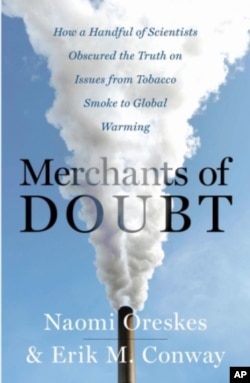
University of California history professor Naomi Oreskes explores why so many Americans are mistrustful of science in "Merchants of Doubt," a book she co-authored with science historian Erik Conway.
The subtitle sums up their thesis: “How a Handful of Scientists Obscured the Truth on Issues from Tobacco Smoke to Global Warming.”
Changing the narrative
The story begins 50 years ago in the tobacco industry, with the announcement by medical researchers that the tar in cigarettes causes cancer. According to Oreskes, tobacco industry leaders were fearful of the financial harm the news might do to their lucrative products, so they turned to a public relations firm to cloud the issue and change the narrative.
“The pattern that they put together was to use many statements that any one of them by themselves might have not been untrue," Oreskes says, "and yet, taken together, created a picture that was untrue. It’s really an extremely clever strategy because the strategy is not to say that 'Tobacco is safe.' The strategy is to say that 'We don’t really know for sure.'”
The tobacco industry funded studies and recruited distinguished scientists to lend authority to these doubts. But Oreskes notes that the specialists’ expertise was not public health, but rather in rocket science and weapons.
“This was part of the strategy that the industry settled on very early in that they would fight science with science, or, as we say in the book, at least with scientists.”
New threat
The same group of scientists later worked together in a Washington think tank to combat the Soviet threat. When the Cold War was over, Oreskes believes they turned their attention to what they saw as a new threat: radical environmentalism.
“It’s what they think is the exaggeration of environmental issues for political reasons. Because they fear that environmental issues like global warming will be used as an excuse for the expansion of government power, the expansion of regulation, the expansion of government control over the marketplace and therefore a kind of slippery slope to socialism.”
In her book, Oreskes argues the current climate change debate is not about the physical warming of the planet - which is well-documented by scientific evidence - but about politics. This explains, she says, why the U.S. Congress rejected an emissions trading plan which would have capped climate-changing carbon emissions.
“Because if the science were truly not settled, then it would be logical to say that we’re not really sure. It would be a mistake to spend a lot of money on alternative technologies, a mistake to have intrusive government regulations, a mistake to have a carbon tax, if we don’t really need those things, if this problem isn’t really real anyway.”
Politicizing the issue
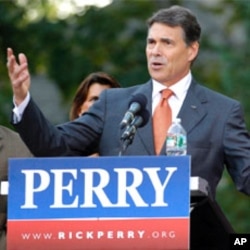
That’s the same line Texas governor and Republican presidential candidate Rick Perry used on a recent campaign stop in New Bedford, New Hampshire. He voiced his opposition to spending what he says would be billions of dollars on emissions reductions programs.
“And I don’t think from my perspective that I want America to be engaged in spending that much money on (what is) still a scientific theory that has not been proven and from my perspective is more and more being put into question,” Perry said.
But the debate over global warming science must be fought on a level playing field, insists Oreskes. Science is not about opinion, she says, it’s about evidence. If a research group claims global-warming is not real or human caused, she says, then they should prove it.
“The burden should be on them to come up with the evidence to show that. And if journalists would demand evidence, what they would find is these people either have no evidence at all in many cases or the supposed evidence that they have is actually distorted. It’s taken out of context. It’s misrepresented or in some cases they are arguments that were published 20 to 30 years ago that have since been refuted.”
In "Merchants of Doubt," Oreskes writes, “Acid rain, secondhand smoke, the destruction of the stratospheric ozone and global warming are all real problems. The real question is how to address them."
Denying their truth, the author argues, “does not make them go away.”