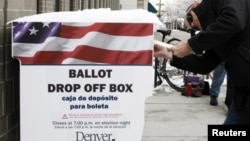
A voter participates in early balloting outside the Denver Elections Division in downtown Denver, Colorado on October 25, 2012.
President Barack Obama and his Republican challenger, Mitt Romney, are engaged in a furious final push for votes with a little more than a week to go before Election Day on November 6.
Both campaigns are going to great lengths to ensure their supporters get to the polls either on or before Election Day.
Public-opinion polls show a very tight race for president and both candidates are targeting a small group of so-called swing states that will determine the outcome.
The southern state of Florida is a frequent stop for both Mitt Romney and President Obama.
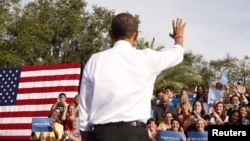
“Florida, I believe in you. I’m asking you to keep believing in me," the president said during a campaign stop this week.
President Obama waves to supporters at a rally in Tampa, Florida, Oct. 25, 2012.
Another prime target is the Midwest state of Ohio, where Romney is urging supporters to get out and vote early.
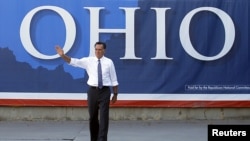
“Because we happen to believe that America faces big challenges and we recognize this is a year with a big choice and Americans want to see big changes, and I’m going to bring it to this country," he told the crowd.
Mitt Romney waves to the crowd at a campaign stop in Worthington, Ohio, Oct. 25, 2012.
More than 30 states offer some sort of early voting opportunity, and analysts believe that will result in 30 to 40 percent of Americans casting their ballots before Election Day.
The president did well among early voters in 2008 and there are some early indications he is repeating that performance this year. But Brookings Institution expert Phil Wallach expects a tight race right up to the end.
“I think the race has stabilized at a dead heat and I think it’s likely that we will go into Election Day not knowing who’s going to come out the winner,” Wallach said.
Both campaigns are making last-minute attempts to win over undecided voters like Gene Greenberg of Virginia. He is drawn to Mitt Romney’s focus on the economy, but wary of the Republican’s conservative views on social issues.
“I agree with their economic principles," Greenberg said. "Their social principles I don’t always agree with, so I have to make that kind of weighted decision on my own.”
Conservative analyst Scot Faulkner believes Romney has the edge in the final days of the campaign, thanks largely to his strong performance in the first presidential debate. More voters now see Romney as a viable alternative to the president, Faulkner said. And both candidates are now focused on making sure their core supporters get out and vote.
“It’s going to be energizing their base," said Faulkner. "They already know who their base votes are and making sure they get out and vote. And at the moment Romney has the fervor [excitement] factor over Obama, but Obama has the ground game over Romney so that makes for a very interesting final phase.”
Several recent national polls have given Romney a slight edge, but analyst Phil Wallach says President Obama may be in a stronger position in the state-by-state tally of electoral votes that decides the winner, Wallach said.
“I think Obama is probably still the slight favorite when we look at the state by state polls. It looks like his road to 270 [electoral votes] is right now a little easier to figure out than Mitt Romney’s.”
Each state is assigned a certain number of electoral votes based on population. In all but two cases, the candidate who wins the popular vote in a given state wins all of that state’s electoral votes. There is a total of 538 electoral votes and the candidate who wins 270 or more of them is elected president.
While concern over the U.S. economy has dominated this election campaign, analyst Scot Faulkner said undecided voters in the final days will also take into account the personal qualities of both men as they make their decision.
“I think the measure of the two men," je said. "It’s the issue of, the president is in your life, in your living room, for four years and who do you want to hear for [the next] four years? Which voice do you want to hear? Which face do you want to see?”
About 40 of the 50 states are considered leaning toward one candidate or the other, so both campaigns are concentrating on nine swing or "battleground" states where the outcome is uncertain. Ohio, Florida, Virginia and Colorado are among those states getting the most attention.
Jim Malone has served as VOA’s National correspondent covering U.S. elections and politics since 1995. Prior to that he was a VOA congressional correspondent and served as VOA’s East Africa Correspondent from 1986 to 1990. Jim began his VOA career with the English to Africa Service in 1983.