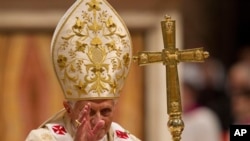
Pope Benedict has condemned the Christmas day attacks at churches in Nigeria, calling them an absurd gesture. Militants of the radical Islamist sect Boko Haram have claimed responsibility for the bombs.
For the second consecutive year, the extremist group Boko Haram has staged Christmastime attacks at Christian houses of worship in Nigeria. The group claimed responsibility for three church bombings on Sunday, Christmas Day.
Security forces in Nigeria also blamed the group for two other explosions in the north of the country.
Speaking from his study window overlooking Saint Peter’s Square on Monday, Pope Benedict condemned the bombings that killed dozens of people.
The pope said he learned with deep sadness of the attacks, which again this year, on the day Jesus was born, have brought mourning and pain in some churches of Nigeria. The pope expressed his closeness to the Christian community and to all those affected by this absurd gesture.
St. Theresa’s Catholic Church in Madala, a satellite town about 40 kilometers from the center of the capital, Abuja, was packed when the first blast exploded just outside after Christmas Mass.
A few hours later, blasts were reported at the Mountain of Fire and Miracles Church in the central, ethnically and religiously mixed town of Jos, and at a church in Gadaka in the northern state of Yobe.
The pope invited everyone to pray for the victims.
He said violence is a path that only leads to pain, destruction and death. He said respect, reconciliation and love are the only path to peace.
The White House also condemned the violence and tragic loss of life. And United Nations Secretary-General Ban Ki-moon spoke out against the attacks and expressed his condolences to the people of Nigeria and to the bereaved families.
Fear is growing in Nigeria that Boko Haram is trying to ignite a sectarian civil war in a country split evenly between Christians and Muslims. The two groups co-exist for the most part in peace, but Jos in particular has suffered through bouts of inter-religious violence that have killed thousands of people.
Boko Haram aims to impose Sharia law across Africa’s most populous country. Authorities blame the group for shootings and bombings that have killed hundreds of Nigerians this year, mostly in the country's northeast.
Pope Benedict Denounces Christmas Attacks in Nigeria