


Scientists at the University of Wisconsin-Madison have developed a technology that turns human motion into electricity.
In this week's journal Nature Communications, they describe how to power a cell phone or other mobile device - like a laptop computer or GPS system - by simply taking a walk.
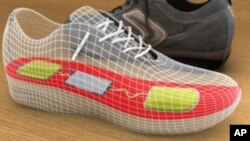
They've embedded an energy harvester in a shoe.
The harvester consists of two small chambers filled with thousands of liquid mini-droplets pushed back and forth when you walk. The fluids flow through flexible plastic tubes with embedded electrodes which directly convert the energy into electric power, which is stored in a tiny battery.
There are no wires in this human-powered mobile phone. It connects to a cellular transmitter also embedded in the shoe, using low-power wireless technology like Bluetooth. That signal is then relayed by the transmitter to the cell tower.
Study co-author and University of Wisconsin engineering professor Tom Krupenkin says such a system dramatically reduces power consumption of the mobile device and allows it to operate for a much longer time.
“That means the cell phone will consume very little energy to do that, literally tens of times less.”
The components are about the size of a credit card. Krupenkin says the main advantage is the system’s always-ready power. Unlike a traditional battery, the energy harvester never needs to be recharged.
“Once you start walking, a standard harvester - which we plan to be about two watts of output power - would start to produce enough power to power your cell phone immediately.”
Krupenkin and colleagues don't expect the device to replace standard batteries, but rather to reduce our dependence on costly and polluting batteries, especially in portable electronics.
“It helps you because you don’t rely on the battery that much and it also helps because it greatly increases the reliability of your power system. You make a system which is potentially always available to you.”
Krupenkin says the technology makes sense for any cell phone or laptop computer user. He also envisions use in remote areas of the world where electrical grids for recharging batteries are not available or expensive, or to relieve the burden on soldiers who must now carry their heavy battery-operated electronic gear into the field.
He expects to have a commercial product on the market within two years.