



News / Middle East

President Obama Welcomes New Iraqi Government

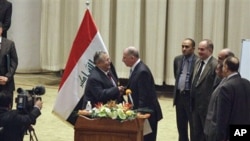
Iraq's President Jalal Talabani, center left, shakes hands with Osama al-Nujeifi, center right, the elected parliament speaker during a Parliament session in Baghdad, Iraq, 11 Nov 2010

Multimedia

TEXT SIZE - +

U.S. President Barack Obama is praising the end of eight months of political stalemate in Baghdad and the formation of a new Iraqi government. Under the deal, Shi'ite Prime Minister Nouri al-Maliki remains in power for another four years, the Sunni-backed Iraqiya coalition gets the parliament speaker position and Kurdish leader Jalal Talabani keeps the presidency.

President Barack Obama called the new Iraqi government inclusive.  "All indications are that the government will be representative, inclusive and reflect the will of the people who cast their ballots in the last election," said President Obama.  "This agreement marks another milestone of history of modern Iraq."

President Obama told reporters in Seoul that Iraqis are showing that their determination to unify their country and build its future is stronger than those who want Iraq to descend into sectarian war and terror.

Iraqi leaders agreed to a deal Wednesday that keeps Shi'ite Prime Minister Nouri al-Maliki in power for another four-year term.

But the deal, that ended an eight-month old stalemate, got off to a rough start Thursday, when about two-thirds of Iraqiya's 91 lawmakers walked out of parliament because they said their demands had not been met.

Mr. Maliki has 30 days to form his cabinet, but the walkout exposes the fragility of the new agreement and the Sunni minority's distrust of Mr. Maliki.

Ordinary Iraqis on the street welcomed the end of the stalemate.  There was also positive reaction in Iraq's mostly Shiite neighbor Iran.

In a sermon during Friday prayers, the head of the Guardian Council, one of Iran's top clerical ruling bodies, praised the Shiite prime minister's return to power in Iraq. He said it was a blow to neighboring, mainly Sunni Arab countries who opposed him.

"Under God's will, the Iraqi people showed their wisdom and vigilance," said Ahmad Jannati, head of the Guardian Council.

If the latest political deal in Iraq holds, it could end the stalemate that has paralyzed Iraqi state institutions since inconclusive elections in March. Insurgents have taken advantage of the political vacuum to stoke violence.

You May Like

Experts Weigh In on Challenges of Closing Guantanamo Prison

Former chief military prosecutor at Guantanamo delivers petition to White House with more than 370,000 signatures, demanding facility be closed down immediately More

Karzai to Discuss Enhancing Defense Ties with India

Afghanistan looking for more military aid as it prepares for withdrawal of NATO forces by next year More

India, China Pledge to Overcome Border Tensions

Indian prime minister and Chinese premier attempt to move past tense standoff in the Himalayas during Delhi talks More

Burmese President Opens US Visit with VOA Town Hall Meeting

Ahead of his meeting with President Obama Monday, Thein Sein answered questions on human rights and economic development in his country More

This forum has been closed.
Comments
     
There are no comments in this forum. Be first and add one

Featured Videos

Your JavaScript is turned off or you have an old version of Adobe's Flash Player. Get the latest Flash player.
Video

Video US Oil Surge Could Impact Mideast Geopolitics

The United States will account for a third of new oil supplies over the next five years, and will become energy self-sufficient in 20 years, according to a new report by the Paris-based International Energy Agency (IEA). Although U.S. oil imports from Arab Gulf countries increased last year, analysts predict the U.S. will lose its dependence on Middle East imports, which is expected to have a huge impact on international relations and the balance of power. VOA's Henry Ridgewell reports.