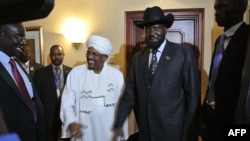
The presidents of Sudan and South Sudan are meeting for a second day as they try to resolve issues left from the two countries' split last year.
Presidents Omar al-Bashir of Sudan and Salva Kiir of South Sudan are meeting in the Ethiopian capital, Addis Ababa, along with African Union mediators.
The AU team has presented ideas for settling the dispute over the oil-producing Abyei region. The proposal, calls for a so-called "soft border" that would allow free movement of people, livestock and goods into both Sudan and South Sudan from Abyei.
In a letter to Kiir, the AU also calls on the sides to decide Abyei's status through talks instead of a poll of the region's people. A poll, says chief AU negotiator Thabo Mbeki, would create hard feelings on the side that lost, and make peace difficult.
Other disputes stemming from South Sudan's July 2011 independence from Sudan involve security, oil revenues, and the status of each country's nationals and one another's territory.
Sudan accuses of the south of arming rebels in two border states, while South Sudan accuses the Sudanese army of bombing raids.
The United Nations gave the two Sudans until this past Saturday to reach an agreement or face possible sanctions.
Presidents Omar al-Bashir of Sudan and Salva Kiir of South Sudan are meeting in the Ethiopian capital, Addis Ababa, along with African Union mediators.
The AU team has presented ideas for settling the dispute over the oil-producing Abyei region. The proposal, calls for a so-called "soft border" that would allow free movement of people, livestock and goods into both Sudan and South Sudan from Abyei.
In a letter to Kiir, the AU also calls on the sides to decide Abyei's status through talks instead of a poll of the region's people. A poll, says chief AU negotiator Thabo Mbeki, would create hard feelings on the side that lost, and make peace difficult.
Other disputes stemming from South Sudan's July 2011 independence from Sudan involve security, oil revenues, and the status of each country's nationals and one another's territory.
Sudan accuses of the south of arming rebels in two border states, while South Sudan accuses the Sudanese army of bombing raids.
The United Nations gave the two Sudans until this past Saturday to reach an agreement or face possible sanctions.