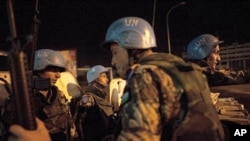
Fighters backing Ivory Coast's internationally-recognized leader are making what they say is a final push on the commercial capital after U.N. and French forces attacked troops still loyal to the incumbent president.
Fighters backing internationally-recognized president Alassane Ouattara fought supporters of incumbent president Laurent Gbagbo for a sixth day in Abidjan following overnight attacks by U.N. and French troops against Gbagbo heavy artillery.
U.N. and French helicopters fired on Gbagbo's main military barracks and his residence after Secretary-General Ban Ki-moon asked President Nicolas Sarkozy for help in silencing mortars and rocket launchers that have been used against civilians and U.N. headquarters in Abidjan.
Gbagbo supporters say the U.N. and French intervention amounts to an assassination attempt against Gbagbo. Ban says the operation is line with the mission's mandate to defend itself and protect civilians and does not mean U.N. troops are taking up arms against Gbagbo.
Pro-Ouattara forces took control of most of the country last week, but have been unable to capture Gbagbo's residence or the presidential palace downtown. Those two sites are now surrounded as Ouattara commanders say they are waiting for Gbagbo to give up.
Ouattara's ambassador in Paris told French radio that he believes Gbagbo is now negotiating the terms of his surrender.
The fighting follows four months of failed negotiations to resolve Ivory Coast's political crisis.
Gbagbo says he was re-elected when the constitutional council annulled as fraudulent nearly ten percent of all ballots cast in November's run-off election. Ouattara's claim to the presidency is based on electoral commission results certified by the United Nations.
The West African regional alliance, the African Union, the United Nations, the European Union, and the United States are all calling on Gbagbo to leave power immediately so Ouattara can take charge.
Nearly one million people have been displaced by this conflict. Civilians in Abidjan say they are running out of food and water.
Fighting Continues in Abidjan After UN, French Attacks