This is Part Two of a five-part series on Eritrea Today
Continue to Parts: 1 / 2 / 3 / 4 / 5
A prominent Eritrean woman has expressed pride in the significant role her countrywomen played in the 30-year struggle for independence from Ethiopia. Eritrea became a separate nation in 1991.
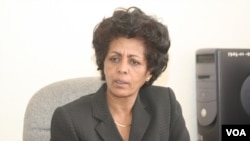
Leul Gebreab, president of the National Union of Eritrean Women, said despite documented successes, more needs to be done to improve the status of women.
Experts say Eritrea women formed about 30 percent of the country’s fighting army during the independence struggle. This, Gebreab said, led many men to change their views about the role of women in what is considered to be a male-dominated society.
“The Eritrean woman [like those in] any other patriarchal society had to fight during [the struggle] against Ethiopian colonialism and also against the patriarchal society that existed,” said Gebreab.
She credits the Eritrean People's Liberation Front (EPLF) for creating the necessary environment for women's empowerment. She said the move was a catalyst for women to fight for their rights as well as for liberation of their country.
Gebreab said her organization is working to achieve social justice for women and to elevate their status.
“We have been working to first change the political scenario whereby women can have equal status in the different decision making roles starting with the household, community, and the high echelons of government. Secondly, we have been working to fight for the girl child to get an education, and the third is the issue of women's health, especially reproductive health. The fourth is the economic empowerment of women,” said Gebreab.
Official statics showed 80 percent illiteracy rates among women before independence. But Gebreab said the government has helped reduce that figure by half and is working to eliminate illiteracy altogether. She says women are also making large strides in education.
“If our women [had been] at the elementary and secondary level non-existent, now they are at 40 percent at the secondary level and almost 50 percent at the elementary level,” said Gebreab.
But UNICEF reports a large gap remains between primary school enrolment rates of boys and girls. According to the UN agency, 2008 data showed 69 percent of boys were enrolled in primary school, compared to 56 percent of girls.
Some observers also note very few Eritrea women are in cabinet positions in government. They say the administration has yet to implement an African Union proposal to guarantee women half of all available positions in government.
But Gebreab said women are advancing economically and politically.
“What we have achieved so far has been great because [of] where we were and what changes have we achieved. [Even] if we have a few women at the high echelons [of government] and [yet] their status at the grass root has not changed, I really do not see this as [real] change in society,” continued Gebreab.
“We are working in parallel at the grass root level and at different echelons of society. This is sustainable rather than having certain quota at certain level and if you could not maintain it, what is the use of that?”
Continue to Parts: 1 / 2 / 3 / 4 / 5
A prominent Eritrean woman has expressed pride in the significant role her countrywomen played in the 30-year struggle for independence from Ethiopia. Eritrea became a separate nation in 1991.
Leul Gebreab, president of the National Union of Eritrean Women, said despite documented successes, more needs to be done to improve the status of women.
Experts say Eritrea women formed about 30 percent of the country’s fighting army during the independence struggle. This, Gebreab said, led many men to change their views about the role of women in what is considered to be a male-dominated society.
“The Eritrean woman [like those in] any other patriarchal society had to fight during [the struggle] against Ethiopian colonialism and also against the patriarchal society that existed,” said Gebreab.
She credits the Eritrean People's Liberation Front (EPLF) for creating the necessary environment for women's empowerment. She said the move was a catalyst for women to fight for their rights as well as for liberation of their country.
Gebreab said her organization is working to achieve social justice for women and to elevate their status.
“We have been working to first change the political scenario whereby women can have equal status in the different decision making roles starting with the household, community, and the high echelons of government. Secondly, we have been working to fight for the girl child to get an education, and the third is the issue of women's health, especially reproductive health. The fourth is the economic empowerment of women,” said Gebreab.
Official statics showed 80 percent illiteracy rates among women before independence. But Gebreab said the government has helped reduce that figure by half and is working to eliminate illiteracy altogether. She says women are also making large strides in education.
“If our women [had been] at the elementary and secondary level non-existent, now they are at 40 percent at the secondary level and almost 50 percent at the elementary level,” said Gebreab.
But UNICEF reports a large gap remains between primary school enrolment rates of boys and girls. According to the UN agency, 2008 data showed 69 percent of boys were enrolled in primary school, compared to 56 percent of girls.
Some observers also note very few Eritrea women are in cabinet positions in government. They say the administration has yet to implement an African Union proposal to guarantee women half of all available positions in government.
But Gebreab said women are advancing economically and politically.
“What we have achieved so far has been great because [of] where we were and what changes have we achieved. [Even] if we have a few women at the high echelons [of government] and [yet] their status at the grass root has not changed, I really do not see this as [real] change in society,” continued Gebreab.
“We are working in parallel at the grass root level and at different echelons of society. This is sustainable rather than having certain quota at certain level and if you could not maintain it, what is the use of that?”