



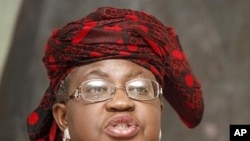
The managing director of the World Bank says Nigeria needs to do a better job living within its means. Ngozi Okonjo-Iweala is President Goodluck Jonathan's choice to be his next finance minister.
Much of Nigeria's budget goes to recurring expenses such as government salaries, defense and social services. World Bank managing director Ngozi Okonjo-Iweala says that is making it hard to find new money to invest in some of the large-scale infrastructure projects that President Jonathan has outlined.
"Right now, I think we need to work very hard because the budget that we have is such that recurrent expenditure is almost 74 percent of the budget and therefore there is not as much left for capital so we need to work hard to put in place, to continue to put in place fiscal policies that will enable us to tackle the various challenges in the economy while at the same time living within our means,” said Ngozi Okonjo-Iweala.
She spoke to senators in Abuja during confirmation hearings to join President Jonathan's cabinet as finance minister, a post she held from 2003 to 2006 before briefly serving as foreign minister in the Olusegun Obasanjo administration.
Okonjo-Iweala spoke cautiously about Central Bank moves toward a cashless society, saying minimum or maximum withdrawal limits could frighten some Nigerians away from keeping their money in banks if they think they are not able to withdraw it.
On the politically-charged issue of price subsidies, she said nearly $4 billion in annual subsidies reach both rich and poor Nigerians, widening the gap between them. She said it is not an ideological issue and believes subsidies work best when they are targeted to the poor.
Nigeria has had a budget deficit for nine of the past 10 years. Domestic debt is also rising. Okonjo-Iweala said the biggest challenge for Nigeria's economy is jobs.
“We have unemployment rate of about 14-16 percent but very large underemployment and the issue is how to make the economy grow in a way that it will create jobs," she said. "So those fiscal policies have to be supportive of the sectors that are going to be job creating.”
Okonjo-Iweala said she is concerned that the foreign reserves of Africa's largest oil and gas producer are falling at a time of high oil prices. But that is partly due to maintaining the value of the naira, a policy that she said she would not seek to reverse.