New Protests Erupt in Islamic Countries Over Video
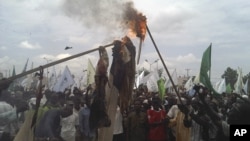
Muslims burn a US flag and a portrait of U.S. President Barrack Obama following a protest in Kano, Nigeria, September 22, 2012.
Muslim demonstrators in Islamic countries and elsewhere held new protests Saturday against an Internet video that mocks the Prophet Muhammad.
In Bangladesh's capital, Dhaka, at least 10 people were injured in clashes between police and protesters.
Security forces fired tear gas and used batons to disperse hundreds of stone-throwing protesters who were part of an alliance of about a dozen Islamic groups. Witnesses say the protesters burned vehicles, including a police van. Some demonstrators were arrested.
The alliance that led the demonstration called for a nationwide strike Sunday to protest the Internet video, which was produced in the United States.
In Pakistan, a government minister announced a $100,000 award for the death of the person who made the film. The minister urged the Taliban and al-Qaida to help locate and kill the filmmaker.
More than 1,000 people rallied Saturday in Pakistan's capital, Islamabad, calling for the filmmaker to be punished.
In Nigeria, thousands of people opposed to the video took to the streets of Kano, the largest city in the country's mainly Muslim north. Demonstrators marched toward the palace of the Emir of Kano, the region's top Muslim spiritual leader.
In Germany, more than 1,000 people against the film marched peacefully in the western city of Dortmund.
Funerals were held in Pakistan for victims of the protests in cities across the country Friday. More than 20 people died in clashes between security forces and demonstrators.
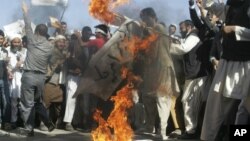
Thousands of Muslims also demonstrated Friday in other countries, including Afghanistan, India, Sri Lanka, Bangladesh, Iraq, Lebanon and Indonesia. Some protesters burned American flags and effigies of U.S. President Barack Obama.
The low-budget Internet video was produced by an anti-Muslim filmmaker in California. It first sparked recent protests in Cairo, and an attack followed on the U.S. consulate in the Libyan city of Benghazi that killed U.S. Ambassador Christopher Stevens and three members of his staff. The Obama administration originally said that attack was a spontaneous response to the Internet video, but U.S. officials have since called it a terrorist attack.
Since the release of the video, anti-U.S. protests have spread as far as Indonesia. Protesters have also voiced anger about images of the Prophet Muhammad, including some of him naked, published in a French magazine.
France's government closed embassies, consulates, cultural centers and schools on Friday in 20 countries as a precautionary measure. French authorities also banned two anti-U.S. protests planned for Saturday.
Some information for this report was provided by AP, AFP and Reuters.
The Voice of America provides news and information in more than 40 languages to an estimated weekly audience of over 326 million people. Stories with the VOA News byline are the work of multiple VOA journalists and may contain information from wire service reports.