



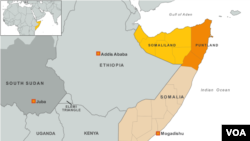
The semi-autonomous Somali region of Puntland is perhaps best known for its pirates. They’ve hijacked many ships and crewmembers demanding millions of dollars in ransom. But efforts are underway to develop Puntland and improve the quality of life for its people.
Besides being home to many Somali pirates, Puntland is also known for its smugglers. They’re often hired by Somali and Ethiopians wanting to cross the Gulf of Aden to Yemen. Many migrants are robbed or killed in the process.
It’s a tough image to shake, but Puntland is a work in progress, according to Paul Crook, who’s chief technical advisor in Somalia for the International Labor Organization.
“We see the power of the negative. The negative image is one of piracy -- that lovely word that conjures up so much and the influence of international criminality and extremist organizations, which still are around. Al Qaeda manifests itself with al Shabab, for example.”
Al Shabab is the main militant group in Somalia. It’s been the target of a long offensive by AU, Somali and Kenyan forces. Much territory has been retaken, but the group has not been defeated.
Poverty and piracy are linked and young, unemployed men see it as a way to improve the quality of their lives and that of their families. Crook said that the international community should do more to break that link by offering alternatives.
“I think it’s very important that we support all the governments in the entire region to enable young people, particularly young men, to feel part of society in terms of employment being a major element of this,” he said.
Puntland is in northeastern Somalia. Its leaders declared it an autonomous state in 1998. The self-declared independent Somaliland lies to the west and has been lobbying for international recognition as a separate nation.
Crook said that it’s unclear whether Puntland would reunite with Somalia once peace returns.
“The opinion changes on an almost monthly basis as we see the vacillations of political processes. Clearly, the case is people see that they are part of a greater nation, if not state, and see the need for collaboration. And this is where the International Labor Organization clearly has a key role in terms of sponsorship of employment-led economic development -- because micro states will have to coalesce to take on the challenges that come with a very fragile environment and the need to create employment on a very large scale.”
Some observers have sad Puntland does indeed want to reunite with Somalia, but wants assurances it would play a major role.
One potential area for employment is oil and gas exploration, which is underway.
“That’s where the international community must come in - and our ability to work with the other international partners - to ensure that whatever the setting that the resources are used for the greater Somali people. And some people will continue to want the status quo where government is still not strong and they can exploit the situation because people can’t hold people accountable,” said Crook.
Recent oil and gas exploration, however, has had disappointing results.
The ILO technical advisor said he recently chaired a meeting in the Puntland capital Garowe of the U.N. Joint Program on Local Governance. The program, he says, supports effective management in district councils.
He added that open debate and dialogue is important for Puntland’s population.
“If you engage openly then people will respond. We just had a Facebook page running in piracy and also on women’s rights. Some of the comments were very, very good. Unfortunately, some people have seen their culture denuded by being part of the Diaspora and use some rather obnoxious language. But the sense is that everybody is able to express a view and will express a view,” he said.
Once people in Puntland agree to something, he said, there is usually a strong commitment to deliver.
“In a sense, it’s taking us back to what we saw many years ago in terms of a handshake and a gentlemen’s agreement.”
However, desire for open debate among the people of Puntland has recently run into a government ban on three radio stations. The Ministry of Information says they lacked the proper licenses. The National Union of Somali Journalists calls the bans and other government action attacks on press freedom.

Besides being home to many Somali pirates, Puntland is also known for its smugglers. They’re often hired by Somali and Ethiopians wanting to cross the Gulf of Aden to Yemen. Many migrants are robbed or killed in the process.
It’s a tough image to shake, but Puntland is a work in progress, according to Paul Crook, who’s chief technical advisor in Somalia for the International Labor Organization.
“We see the power of the negative. The negative image is one of piracy -- that lovely word that conjures up so much and the influence of international criminality and extremist organizations, which still are around. Al Qaeda manifests itself with al Shabab, for example.”
Al Shabab is the main militant group in Somalia. It’s been the target of a long offensive by AU, Somali and Kenyan forces. Much territory has been retaken, but the group has not been defeated.
Poverty and piracy are linked and young, unemployed men see it as a way to improve the quality of their lives and that of their families. Crook said that the international community should do more to break that link by offering alternatives.
“I think it’s very important that we support all the governments in the entire region to enable young people, particularly young men, to feel part of society in terms of employment being a major element of this,” he said.
Puntland is in northeastern Somalia. Its leaders declared it an autonomous state in 1998. The self-declared independent Somaliland lies to the west and has been lobbying for international recognition as a separate nation.
Crook said that it’s unclear whether Puntland would reunite with Somalia once peace returns.
“The opinion changes on an almost monthly basis as we see the vacillations of political processes. Clearly, the case is people see that they are part of a greater nation, if not state, and see the need for collaboration. And this is where the International Labor Organization clearly has a key role in terms of sponsorship of employment-led economic development -- because micro states will have to coalesce to take on the challenges that come with a very fragile environment and the need to create employment on a very large scale.”
Some observers have sad Puntland does indeed want to reunite with Somalia, but wants assurances it would play a major role.
One potential area for employment is oil and gas exploration, which is underway.
“That’s where the international community must come in - and our ability to work with the other international partners - to ensure that whatever the setting that the resources are used for the greater Somali people. And some people will continue to want the status quo where government is still not strong and they can exploit the situation because people can’t hold people accountable,” said Crook.
Recent oil and gas exploration, however, has had disappointing results.
The ILO technical advisor said he recently chaired a meeting in the Puntland capital Garowe of the U.N. Joint Program on Local Governance. The program, he says, supports effective management in district councils.
He added that open debate and dialogue is important for Puntland’s population.
“If you engage openly then people will respond. We just had a Facebook page running in piracy and also on women’s rights. Some of the comments were very, very good. Unfortunately, some people have seen their culture denuded by being part of the Diaspora and use some rather obnoxious language. But the sense is that everybody is able to express a view and will express a view,” he said.
Once people in Puntland agree to something, he said, there is usually a strong commitment to deliver.
“In a sense, it’s taking us back to what we saw many years ago in terms of a handshake and a gentlemen’s agreement.”
However, desire for open debate among the people of Puntland has recently run into a government ban on three radio stations. The Ministry of Information says they lacked the proper licenses. The National Union of Somali Journalists calls the bans and other government action attacks on press freedom.