


MOSCOW — After years of complaining about American troops in Afghanistan, Russian President Vladimir Putin is now urging them to stay. At the same time, however, he is preparing a fallback plan.
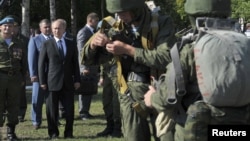
Russia’s elite parachutist soldiers welcomed Putin on a visit last week to Ulyanovsk, an air base city on the flight path between Moscow and Afghanistan.
During the 1980s, Ulyanovsk was a major staging area for Soviet troops fighting in Afghanistan. This month, it became a staging area for NATO supplies shipped out of Afghanistan.
For Russian communists, who revere the city as the birthplace of Lenin, this was one step too close to NATO.
This Communist speaker at a mass protest rally in Ulyanovsk warned that “NATO boots” on Russian soil would mean a loss of sovereignty.
Putin praised the paratroopers’ Soviet-era service in Afghanistan. Then he asked them if they want to go there now. The answer? "Nyet!"
Putin then said: “We should not be fighting there again. Let them sit there and fight.” Then Russia’s president said that NATO countries “took up this burden" and should, as he put it, "carry it to the end.”
Alexey Malashenko, Central Asia expert at the Carnegie Moscow Center, said Putin’s remarks were aimed at Russian listeners.
“It’s a question to show to Russian army, to Russian society, to Russia, that we are more clever than the Americans, than the West. They are involved in the Afghanistan problem, we can help them, but we laugh at them because they made the same mistakes that we did before in the Soviet Union,” said Malashenko.
But Russia’s leader knows that a slow-motion Western troop pullout from Afghanistan is underway. On Monday, Belgium started to withdraw its soldiers. By the end this year, the United States is to draw down about one third of its troops in Afghanistan.
In response, Russia is working on a strategy for post-NATO Afghanistan. It is negotiating long-term base agreements with Kyrgyzstan and Tajikistan.
Russia’s fear is that Islamic fundamentalism will spread north from Afghanistan. Kyrgyzstan already is tracking roughly 1,500 homegrown extremists. Closer to the Afghan border, major gun battles erupted two weeks ago in Tajikistan, killing 50 people. The Tajik government blamed the fighting on more than 400 extremists from Afghanistan.
More Tajiks live in Afghanistan than in Tajikistan. At the same time, Russia maintains 6,000 soldiers deployed in Tajikistan, Moscow’s largest deployment outside of Russia.
Andrei Kazantsev, analytical director at the Moscow State Institute of International Relations, believes that Moscow plans to hold the line at Tajikistan's border with Afghanistan.
“It is very clear that Russia will be supporting the Tajik minority, and will be among the first of international powers that will help Tajiks in Afghanistan to survive,” said Kazantsev.
So for now, the Kremlin will encourage NATO to fight on in Afghanistan.
At the same time, Moscow will be preparing to fall back to its position of the 1990s, when it supported the Northern Alliance. That Tajik-led coalition maintained a buffer zone between the Taliban and the lands once known as Soviet Central Asia.
Russia’s elite parachutist soldiers welcomed Putin on a visit last week to Ulyanovsk, an air base city on the flight path between Moscow and Afghanistan.
During the 1980s, Ulyanovsk was a major staging area for Soviet troops fighting in Afghanistan. This month, it became a staging area for NATO supplies shipped out of Afghanistan.
For Russian communists, who revere the city as the birthplace of Lenin, this was one step too close to NATO.
This Communist speaker at a mass protest rally in Ulyanovsk warned that “NATO boots” on Russian soil would mean a loss of sovereignty.
Putin praised the paratroopers’ Soviet-era service in Afghanistan. Then he asked them if they want to go there now. The answer? "Nyet!"
Putin then said: “We should not be fighting there again. Let them sit there and fight.” Then Russia’s president said that NATO countries “took up this burden" and should, as he put it, "carry it to the end.”
Alexey Malashenko, Central Asia expert at the Carnegie Moscow Center, said Putin’s remarks were aimed at Russian listeners.
“It’s a question to show to Russian army, to Russian society, to Russia, that we are more clever than the Americans, than the West. They are involved in the Afghanistan problem, we can help them, but we laugh at them because they made the same mistakes that we did before in the Soviet Union,” said Malashenko.
But Russia’s leader knows that a slow-motion Western troop pullout from Afghanistan is underway. On Monday, Belgium started to withdraw its soldiers. By the end this year, the United States is to draw down about one third of its troops in Afghanistan.
In response, Russia is working on a strategy for post-NATO Afghanistan. It is negotiating long-term base agreements with Kyrgyzstan and Tajikistan.
Russia’s fear is that Islamic fundamentalism will spread north from Afghanistan. Kyrgyzstan already is tracking roughly 1,500 homegrown extremists. Closer to the Afghan border, major gun battles erupted two weeks ago in Tajikistan, killing 50 people. The Tajik government blamed the fighting on more than 400 extremists from Afghanistan.
More Tajiks live in Afghanistan than in Tajikistan. At the same time, Russia maintains 6,000 soldiers deployed in Tajikistan, Moscow’s largest deployment outside of Russia.
Andrei Kazantsev, analytical director at the Moscow State Institute of International Relations, believes that Moscow plans to hold the line at Tajikistan's border with Afghanistan.
“It is very clear that Russia will be supporting the Tajik minority, and will be among the first of international powers that will help Tajiks in Afghanistan to survive,” said Kazantsev.
So for now, the Kremlin will encourage NATO to fight on in Afghanistan.
At the same time, Moscow will be preparing to fall back to its position of the 1990s, when it supported the Northern Alliance. That Tajik-led coalition maintained a buffer zone between the Taliban and the lands once known as Soviet Central Asia.