



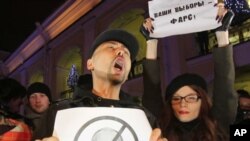
Thousands of protesters turned out in Moscow to denounce Prime Minister Valdimir Putin and his United Russia party Monday - one day after parliamentary elections that international observers and opposition leaders said were marred by fraud.
Despite winning the most seats in the State Duma, the lower house, the party that has dominated Russian politics for more than a decade took about 50 percent of the vote and now holds 238 of the 450 parliamentary seats. In the last election, in 2007, United Russia won 64 percent of the vote.
The protesters gathered under pouring rain to denounce the election, chanting "Russia without Putin." Scores were arrested as they sought to march toward the Kremlin. It was once of the biggest protests in the Russian capital in years.
Earlier on Monday election monitors from the Organization for Security and Cooperation in Europe (OSCE) reported many violations of election rules favoring the United Russia party. The OSCE says frequent procedural violations included problems with the vote-counting, ballot-box stuffing and a lack of fairness.
Photo Gallery: Russia votes
The Obama administration has expressed "serious concerns" about the conduct of the election and called for a full investigation into what U.S. Secretary of State Hillary Clinton called "credible reports of electoral fraud and manipulation." But Russian President Dmitry Medvedev insisted the elections were "fair, honest and democratic."
"United Russia gained exactly what it has, no more and no less than that. In that sense, they were absolutely honest and fair and democratic elections," said Medvedev.
The Communists, along with the nationalist Liberal Democrats and Just Russia - a social democratic party - all made strong gains, meaning that Putin's party will be forced to work with members of the newly empowered opposition. The Communist Party took 92 seats, followed by Just Russia with 64 and the Liberal Democrats with 56.
Russian analysts in recent weeks had predicted a sharp decline in the ruling party's popularity, with voters voicing discontent about the growing income gap between Russia's rich and poor, and allegations of official corruption. There have also been expressions of discontent over plans by Putin to reclaim the presidency in March after being forced to assume the post of prime minister in 2008 due to term limits.
If he regains the presidency, the 59-year-old Putin could serve two more 6-year terms and remain in power until 2024. He was first elected president in 2000.
Some information for this report was provided by AP, AFP and Reuters.