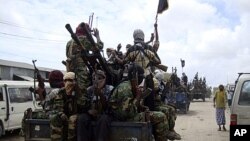



The Kenyan military says airplanes full of weapons meant for militant group al-Shabab landed in Somalia this week. The unconfirmed reports heighten longstanding suspicions that Eritrea is arming the militants. Eritrea's foreign ministry denies the charge, but the question remains: From whom is al-Shabab receiving support?
Rashid Abdi, a Horn of Africa analyst with International Crisis Group, addresses that question and more.
I wanted to ask you about these newspaper reports that Eritrea is arming al-Shabab. Is there any truth to this that you know of? And what is the relationship, historically, between Eritrea and al-Shabab?
"I think the first thing I would say is that it's actually very difficult to reliably confirm these reports independently. I think no one doubts that Eritrea has throughout the last four years been supportive of al-Shabab, sending in weapons, sending in trainers and also training hundreds of al-Shabab fighters in some of its military camps. But I think, as I said, it's very difficult to confirm this news story that this support has been resumed by Eritrea.
What is Eritrea's incentive?
"Well, Eritrea definitely has been supportive of al-Shabab for a long time and this support is not ideological. It's essentially meant to counter Ethiopia's influence in Somalia and, during the Ethiopian occupation, that was the height of Eritrea's involvement in Somalia."
And what other foreign assistance has al-Shabab received? There have been reports that there have been more foreign fighters coming in to join their ranks. Do you know anything about that?
"Yes, I think there has been a trickle of foreign fighters into Somalia throughout [the conflict], and increasingly al-Shabab has been very actively recruiting from Somali diaspora communities scattered all over. So, they still have pools of supporters on whom they can rely to raise funds and also potentially to recruit, but sometimes these [reports] are exaggerated. I think the organization itself is under a lot of political pressure and its support has been waning considerably. It's by no means a diminished political organization, but no one doubts that al-Shabab is finding it very difficult now to recruit and to raise funds."
In the past, though, when foreign armies have come into Somalia, it's helped to boost support for al-Shabab. Is there any indication that's happening now?
"It's probably too early to say that al-Shabab is gaining from Kenya's military intervention, but probably if Kenya's intervention becomes prolonged and then you have serious civilian casualties, then the tide may quickly turn in favor of al-Shabab, and al-Shabab will definitely whip up ultra-nationalism as they have done in the past (and) benefit from playing the nationalist card."
And on the other side, a lot of past fighting in Somalia has often been characterized as proxy wars that are really serving the interests of other regional or international actors. I'm wondering if that's happening now and who the actors might be. Because, you know, a lot of foreign governments have been totally silent about whether they are supporting Kenya's incursion.
"Yes, again it's very difficult to know who are the parties that are supporting Kenya's military intervention. But I think some of the reports that have emerged in recent weeks -- that the Kenyan military may be getting some form of logistical and intelligence support from some of its traditional western allies -- may be credible. But again, I think the report may be exaggerated; again, I think many countries are deeply worried about Kenya's intervention, fearing of course that that may be what al-Shabab needs to regain some of the political losses it has suffered."
And finally I wanted to ask about the mixed signals we're getting from Somalia's leadership. You know last week Somalia's president came out and said he was against Kenya's incursion. Then the prime minister had to come out and say, "No, we're on the same page, and we support Kenya's military action." What do you make of the mixed signals?
"I think there's no doubt that President Sharif is in some kind of a quandary, because, you know, he is aware of how unpopular Kenya's intervention is domestically. And he knows there are probably significant numbers in parliament, MPs, who are deeply opposed to this intervention. So he fears that if he comes out openly in support, then that may give extra ammunition to some of his rivals within the government, and, also, that [it] may not go down well within the domestic constituency itself. So this is probably what explains this confusion and the ambivalence on the part of Sharif to come out openly and support the Kenyan military intervention."
Q&A: Who's Supporting Al-Shabab?
- By Gabe Joselow