



The international Quartet of Middle East peace mediators says there is an "urgent" need for renewed talks between Israel and the Palestinians due to political unrest in Egypt and other Arab nations.
In a statement Saturday, the Quartet urged Israel, the Palestinians and others concerned to "expedite" Israeli-Palestinian peace efforts and a comprehensive Arab-Israeli peace. It says delaying such talks while unrest continues in Egypt and elsewhere will be "detrimental" to regional peace and security.
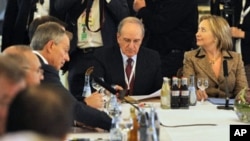
The Quartet issued the statement following a meeting in Munich of its senior representatives, including U.S. Secretary of State Hillary Clinton, EU foreign policy chief Catherine Ashton, Russian Foreign Minister Sergei Lavrov and U.N. Secretary-General Ban Ki-moon.
Ashton said recent events in the Middle East mean it is "hugely important" that progress is made in the peace process.
Egyptian President Hosni Mubarak has long been a major player in efforts to mediate between Israel and the Palestinians. Western government fear that days of mass protests demanding his resignation after three decades in office could boost the power of Egyptian Islamists opposed to peace with Israel.
Israeli-Palestinian peace talks broke down last September, when Israel rejected Palestinian demands to extend a freeze on Jewish settlement expansion in the occupied West Bank - land claimed by the Palestinians for a future state.
The Quartet expressed "regret" with Israel's "discontinuation" of the 10-month moratorium on West Bank housing construction. It also said unilateral actions by either party cannot prejudge the outcome of negotiations.
Palestinian President Mahmoud Abbas has secured diplomatic recognition of an independent Palestine from several nations in recent months.
The Quartet also welcomed an Israeli agreement to undertake a series of measures to boost Palestinian economic development in the West Bank and facilitate the rebuilding of war-damaged infrastructure in the Gaza Strip.
Israeli Prime Minister Benjamin Netanyahu announced the steps Friday, after meeting Quartet envoy Tony Blair. Palestinian negotiator Saeb Erekat rejected the promised Israeli measures, calling them a deception.
He also expressed disappointment with the Quartet's statement, saying the Palestinians had expected the mediators to demand a stop to Israeli settlement activity.
The Quartet says its envoys will hold separate talks with Israeli and Palestinians negotiators in Brussels before meeting again in mid-March.
Some information for this report was provided by AP, AFP and Reuters.