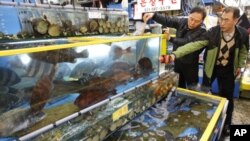
Fear about radiation from the nuclear power plant disaster in Japan is causing sales of seafood to dive in South Korea.
At the Garak fish market, the sales pitches about fresh and cheap seafood that would usually entice customers are falling on deaf ears.
A fishmonger, who has changed her tune, continually repeats that all of her seafood is Korean.
But there are few takers, compared to previous weeks - even though only 10 percent of the seafood at the Seoul market comes from Japan.
Fishmongers say sales have dropped by half as a result of the incessant headlines about radiation in seawater near the Fukushima nuclear power plant.
Kim Hyun-yi says she and her colleagues are now throwing away pollock, by the boxes. The whitefish used to sell for between $70 and $80 per box. She says the price was reduced, earlier in the week, to $5, but still no one would buy.
Another fishmonger, Lee Eun-young, says all people browsing are asking about the origin of the seafood displayed.
Lee says it is difficult to sell anything but frozen fish. She says restaurant owners buy in bulk, but they have become reluctant to purchase, and some are apparently temporarily closing their businesses while the radiation scare continues.
Shopper Chung Myung-sun says the troubles with the Japanese nuclear power plant are prompting a change in her household’s eating habits.
Chung says she is trying to avoid buying fish, altogether, and is switching to vegetables. The only fish she will consider has to be frozen and caught before the radiation outbreak.
Also shopping at the market is restaurant owner Kim Shun-hwa. She says fresh pollock is definitely off her restaurant’s menu.
Kim says, if word got out that she was serving it, business would definitely suffer. So the only pollock she will consider is the frozen variety. And, she is also worried about the safety of squid, because it comes from the waters between Japan and the Korean peninsula.
South Korea’s government has banned the import of food from areas surrounding the Fukushima nuclear complex. It says it is screening all fishery products from Japan for radiation contamination,
The Fukushima-1 nuclear power plant, on Japan’s northeastern Pacific coast, was crippled by a March 11 magnitude 9.0 earthquake and resulting tsunami, which topped 10 meters in height in some locations.
Since then, workers have struggled to bring the damaged reactors under control, but the plant continues to spew radiation into the atmosphere and sea water.
Seafood Sales Sink in S. Korea Due to Radiation Fears