


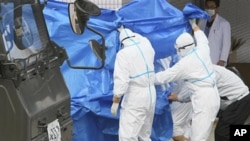
Authorities in Japan are continuing efforts to control the crisis at a damaged nuclear power plant. The Fukushima-1 complex was damaged after a massive earthquake two weeks ago and is still emitting radiation in the atmosphere
On the outside, steam continued to rise Friday from several reactor buildings at the Fukushima-1 nuclear facility in northeastern Japan. Inside, work continued to try to bring automated cooling systems back on line that would help prevent an even potentially worse spread of radiation from the severely damaged complex.
Japan's government has recommended that people living between 20 and 30 kilometers from the facility leave their homes, but no mandatory evacuation is being issued for that zone. Those within 20 kilometers were previously ordered out of the area due to radiation fears.
Hidehiko Nishiyama, the deputy director of the Nuclear and Industrial Safety Agency, says it is possible that radioactive matter will continue to travel far away and testing about the extent of the emissions needs to be made.
The continuing emission of radioactive vapor has prompted warnings about drinking tap water as far away as 300 kilometers south of the plant. It has also raised safety concerns internationally about Japanese vegetables, milk and seafood.
Two of three workers laying cables in the turbine building of Reactor-3 slipped into radioactive water and were transferred by ambulance to a specialized hospital Friday. They are to be treated at the National Institute of Radiological Science after suffering radiation burns on their feet the previous day.
Japan's trade minister, Banri Kaieda, blames a "safety lapse" for exposing the men to 100,000 times the normal level of radiation found in water used for reactor cooling.
Kaieda blames a lack of management supervision by Tokyo Electric Power Company for the exposure. He says the utility needs to improve its radiation oversight at the crippled nuclear power facility.
Japan's defense ministry says pure water and pumps supplied by the United States military will be brought to Fukushima-1 to cool the reactors. It would replace the sea water being used that is causing corrosion because of an accumulation of tons of salt.
Scientists say chloride in the salt could also break open the zirconium alloy layer of protection around the fuel rods which prevents volatile radioactive elements from escaping.
Tokyo Electric Power confirms that zirconium-95 in sea water several hundred meters from the Fukushima plant has been detected since Wednesday when testing began there for additional radioactive elements.
A spokesman for the Japanese prime minister's office tells VOA there is no clear evidence that the cladding has been breached.
Since the March 11 magnitude 9.0 earthquake and resulting tsunami, high radiation levels, fires and explosions at some of the six reactors have slowed efforts to make critical repairs to stabilize the situation.
Japanese government agencies say they are considering raising the assessment of the nuclear crisis to a level six or "serious accident" on the International Nuclear and Radiological Event Scale. Currently, the Fukushima accident is rated a level five, which is considered to "have wider consequences."
The official death toll from the March 11 quake and tsunami continues to rise. The national police agency says more than 10,000 fatalities have been confirmed while more about 17,000 people are missing.