


News / Middle East

Rafik Hariri's Legacy Continues in Lebanon

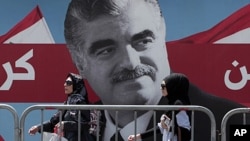
Lebanese women pass by a giant portrait of slain Lebanese Prime Minister Rafik Hariri near his grave in downtown Beirut, Lebanon, June 30, 2011.
TEXT SIZE - +

Former Lebanese Prime Minister Rafik Hariri was considered a powerful political force in Lebanon and throughout the Arab world, before his 2005 death in a truck bombing that targeted his motorcade in Lebanon.

On Thursday, more than six years after his assassination, Lebanese media reported that a United Nations backed tribunal issued four arrest warrants and a sealed indictment to Lebanon's prosecutor general.

Crucial role


Hariri served as prime minister first between 1992 and 1998 and for another four-year stint starting in 2000. His family has and continues to play a crucial role in Lebanese politics and economic development.

Hariri was born in Lebanon in 1944 to a Sunni Muslim farmer and grocer.

At the age of 20, he enrolled at Beirut Arab University, but dropped out a year later without a degree. He then moved to Saudi Arabia where he worked as a teacher, but went on to amass his fortune in construction.

Billionaire businessman

The billionaire businessman was widely considered the main driving force behind the reconstruction of Beirut following Lebanon's civil war, which lasted from 1975 to 1990.

After coming into office, Hariri slashed income and corporate taxes, and borrowed billions of dollars to rebuild the infrastructure of the capital, a move that drastically slowed economic growth, putting Lebanon's economy on the verge of collapse.

Corruption accusations

During this time, the Hariri government was accused of rampant corruption. He was ousted in 1998. Hariri then returned to office two years later, but resigned in 2004 after several long-standing public disagreements over the role of Syria in Lebanon.

After his death, Saad Hariri, Rafik Hariri's son, became prime minister in 2009, but was forced out in January in a political feud with the Shi'ite militant group Hezbollah, over the tribunal.

Hezbollah had been pressing Hariri to disavow the tribunal, but on Thursday he praised its findings.

Some information for this report was provided by AP, AFP and Reuters.
You May Like

Experts Weigh In on Challenges of Closing Guantanamo Prison

Former chief military prosecutor at Guantanamo delivers petition to White House with more than 370,000 signatures, demanding facility be closed down immediately More

Karzai to Discuss Enhancing Defense Ties with India

Afghanistan looking for more military aid as it prepares for withdrawal of NATO forces by next year More

India, China Pledge to Overcome Border Tensions

Indian prime minister and Chinese premier attempt to move past tense standoff in the Himalayas during Delhi talks More

Burmese President Opens US Visit with VOA Town Hall Meeting

Ahead of his meeting with President Obama Monday, Thein Sein answered questions on human rights and economic development in his country More

This forum has been closed.
Comments
     
There are no comments in this forum. Be first and add one

Featured Videos

Your JavaScript is turned off or you have an old version of Adobe's Flash Player. Get the latest Flash player.
Video

Video US Oil Surge Could Impact Mideast Geopolitics

The United States will account for a third of new oil supplies over the next five years, and will become energy self-sufficient in 20 years, according to a new report by the Paris-based International Energy Agency (IEA). Although U.S. oil imports from Arab Gulf countries increased last year, analysts predict the U.S. will lose its dependence on Middle East imports, which is expected to have a huge impact on international relations and the balance of power. VOA's Henry Ridgewell reports.