



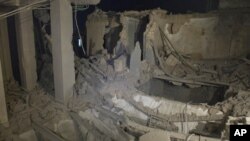
At least five loud blasts from apparent NATO airstrikes were heard in the Libyan capital, Tripoli, early Tuesday.
The unusually heavy bombardment followed separate NATO air attacks Monday against government weapons depots near the western town of Zintan.
In the besieged port city of Misrata, rebel fighters said they have pushed back government troops from positions ringing the town. A ship chartered by the International Committee of the Red Cross arrived in Misrata Monday, bringing 8,000 jars of baby food as well as urgently needed surgical instruments and medical dressings.
Earlier, the United Nations said a ship carrying 600 refugees from Libya sank off the country's coast Friday, with an unknown death toll.
Salah Kurdi, a legal adviser with the U.N. Human Rights Council in Geneva, told VOA the boat was heading to Italy from the Libyan capital when it hit rocks and capsized. He said the Italian coast guard rescued many passengers, but that he had no details about casualties.
Kurdi also disclosed an earlier incident in which a smaller boat fleeing Libya ran into trouble soon after leaving Tripoli. The vessel floated helplessly on the open sea for 16 days and by the time it drifted ashore - back in Libya - most of the 72 people on board were dead or dying of hunger and thirst.
Those who survived the ill-fated voyage - all African nationals who had migrated to or were working in Libya - said NATO military units saw their plight but failed to provide any help. NATO denied the refugees' claim, but the British newspaper The Guardian investigated and reported that NATO units apparently ignored the Africans' pleas.
The Guardian reported that the ship carried 47 Ethiopians, seven Nigerians, seven Eritreans, six Ghanaians and five Sudanese. All but 11 were dead when the ship landed back in Libya last month, and two of those who survived the ordeal at sea died later in hospitals.
Passengers on the ship told reporters they drifted close to an aircraft carrier and were certain they had been spotted, but no help ever arrived. A military helicopter flew low over the refugees' ship on another occasion, but again no assistance was given.
U.N. aid chief Valerie Amos said more than 746,000 people have fled Libya since the fighting began in February, and about 5,000 remain stranded at border points in Egypt, Tunisia and Niger.
Amos told the U.N. Security Council Monday that the way international sanctions are implemented in Libya is delaying the delivery of supplies to the country's embattled population. She said one problem is Libya's centralized distribution system.
The U.N. humanitarian coordinator also asked all parties in the fighting to agree to a temporary pause in hostilities to enable the delivery of food, water, medical supplies and other aid to needy populations.
Some information for this report was provided by AP, AFP and Reuters.