



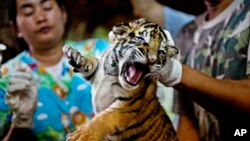
An environmental group has accused China's government of supporting an underground trade of tiger skins and other body parts, despite signing global initiatives to protect the animals.
The London-based Environmental Investigation Agency (EIA) on Tuesday said it has uncovered a "legalized domestic trade" in the skins of captive-bred tigers that are being sold as luxury home decor.
The group says the farms, which receive the support and funding from the State Forestry Administration, are stimulating demand for the tiger parts, and encouraging the poaching of wild tigers and other big cats across Asia.
It also says it has uncovered a secret government notice that allows the sale of tiger bone wine, which is thought to have medicinal qualities in some parts of China.
China has signed the U.N. Convention on International Trade in Endangered Species, which prohibits international commercial trade in tiger parts and derivatives. It also calls for domestic trade prohibitions. A foreign ministry spokesperson said Tuesday the government places "great importance" on the protection of wildlife, including tigers.
But the EIA says the treaty is having little effect. It accused China of having an "intolerable disconnect between words and deeds," saying Beijing "puts the 'con' in tiger conservation."
The group says it wants Beijing to send a clear message to all breeders, consumers and the tiger industry that its official policy is to end all demand and trade.
EIA says there are more than 5,000 captive-bred tigers being held in Chinese farms and zoos. It says they are not being bred for conservation purposes.
The group estimates are as few as 3,500 wild tigers in China. Beijing has pledged to double the number of wild tigers by 2022.
The London-based Environmental Investigation Agency (EIA) on Tuesday said it has uncovered a "legalized domestic trade" in the skins of captive-bred tigers that are being sold as luxury home decor.
The group says the farms, which receive the support and funding from the State Forestry Administration, are stimulating demand for the tiger parts, and encouraging the poaching of wild tigers and other big cats across Asia.
It also says it has uncovered a secret government notice that allows the sale of tiger bone wine, which is thought to have medicinal qualities in some parts of China.
China has signed the U.N. Convention on International Trade in Endangered Species, which prohibits international commercial trade in tiger parts and derivatives. It also calls for domestic trade prohibitions. A foreign ministry spokesperson said Tuesday the government places "great importance" on the protection of wildlife, including tigers.
But the EIA says the treaty is having little effect. It accused China of having an "intolerable disconnect between words and deeds," saying Beijing "puts the 'con' in tiger conservation."
The group says it wants Beijing to send a clear message to all breeders, consumers and the tiger industry that its official policy is to end all demand and trade.
EIA says there are more than 5,000 captive-bred tigers being held in Chinese farms and zoos. It says they are not being bred for conservation purposes.
The group estimates are as few as 3,500 wild tigers in China. Beijing has pledged to double the number of wild tigers by 2022.