



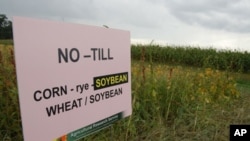
Genetically engineered crops have had a positive impact on the environment and on many farmers' profits, according to a new report by the U.S. National Research Council. But the report says poor management threatens some of those benefits.
Nearly half of the farmland in the United States is planted with crops that have been genetically engineered, mainly maize, soybeans and cotton.
There are two major traits among these GE crops: resistance to certain insect pests, and resistance to a weed-killer called glyphosate. The new report looked at research comparing the environmental impact of GE crops to conventional crops.
"In general, we find that genetically engineered crops have had fewer adverse effects on the environment than non-GE crops produced conventionally," says report co-author LaReesa Wolfenbarger, a biology professor at the University of Nebraska.
Fewer chemicals, less tillage
Wolfenbarger says insect-resistant GE crops have fewer adverse effects because farmers don't have to spray as many toxic insecticides. And farmers planting glyphosate-resistant crops can use just one less-toxic herbicide to control weeds. And they often don't have to till at all, which is better for the soil.
And many farmers growing GE crops have seen economic benefits like higher yields, lower costs, and more flexibility than their conventional-farming counterparts.
Weeds strike back
However, farmers have relied so heavily on glyphosate that at least eight species of weeds are now resistant to it. Ervin says that means some farmers have returned to using soil-disturbing tillage or more toxic herbicides to control weeds.
"We really need to get after this weed resistance problem right away before we lose the efficacy of that technology," says report committee chair David Ervin of Portland State University. "There's just too much at stake to lose that, economically, environmentally, and perhaps even socially."
That's a view shared by Gregory Jaffe at the consumer group, the Center for Science in the Public Interest.
"The report reconfirms that we still need a strong regulatory system to ensure that the technology is not squandered away by poor management practices by both farmers and seed developers," Jaffe says.
Big questions remain
The report was intended to assess the environmental, economic, and social impact of GE crops on farm sustainability in the United States.
But, Ervin says, "We could not complete that assessment at this point because we don't have sufficient evidence."
For example, the report says the widespread adoption of no-till agriculture by farmers using glyphosate-resistant crops should reduce soil erosion, which is the largest source of water pollution in the United States. But there is no mechanism to track these effects.
The report also notes a lack of research on the economic impacts of widespread adoption of GE crops on the livestock industry, which is their biggest consumer, or on farmers who do not grow GE crops.
Non-GE organic crops can often fetch a premium price. But Bob Scowcroft, director of the Organic Farming Research Foundation, says in four surveys over the past decade, "We've documented organic farmers that have lost their [organic] certification because of GE contamination" from neighboring farmers' crops.
The report calls for more resources to study these important questions so farmers, seed developers, and policymakers can make better decisions.