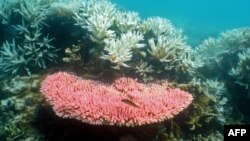
A new study has found that Australia's Great Barrier Reef, the world's largest living organism, has lost more than half its coral in the past three decades.
Scientists from the Australian Institute of Marine Science say damage from cyclones and a population explosion of predatory "crown of thorns" starfish are mostly to blame for devastating the World Heritage Site. To a lesser extent, coral bleaching resulting from ocean warming was blamed.
Jamie Oliver, an AIMS scientist who helped write the report, says reducing the population of starfish that feed on the coral is the best way to prevent a further destruction to the reef.
"We believe that if we can take action on one of the things we can directly control, the crown of thorns starfish, it may leave the reef in a position where it can better withstand some of these climatic impacts, such as cyclones and coral bleaching," said Oliver.
Watch Video here: Crown of thorns starfish
But the report also said that easing global climate change and improving water quality around the reef were essential for its future. Without intervention, scientists say the amount of coral could halve again by 2022.
The Great Barrier Reef covers an area of about 345,000 square kilometers off the coast of northeast Australia.
Though the report said coral loss at the reef has been running at about .53 percent annually since 1985, it said that most of the damage had occurred in the southern regions and that the relatively pristine northern region is relatively stable.
Scientists from the Australian Institute of Marine Science say damage from cyclones and a population explosion of predatory "crown of thorns" starfish are mostly to blame for devastating the World Heritage Site. To a lesser extent, coral bleaching resulting from ocean warming was blamed.
Jamie Oliver, an AIMS scientist who helped write the report, says reducing the population of starfish that feed on the coral is the best way to prevent a further destruction to the reef.
"We believe that if we can take action on one of the things we can directly control, the crown of thorns starfish, it may leave the reef in a position where it can better withstand some of these climatic impacts, such as cyclones and coral bleaching," said Oliver.
Watch Video here: Crown of thorns starfish
But the report also said that easing global climate change and improving water quality around the reef were essential for its future. Without intervention, scientists say the amount of coral could halve again by 2022.
The Great Barrier Reef covers an area of about 345,000 square kilometers off the coast of northeast Australia.
Though the report said coral loss at the reef has been running at about .53 percent annually since 1985, it said that most of the damage had occurred in the southern regions and that the relatively pristine northern region is relatively stable.